A Simple Genetic Algorithm for Function Optimization
This research investigates the application of Genetic Algorithms (GA) as a powerful soft computing technique for function optimization. Unlike traditional hard computing methods, GA offers fast convergence and the ability to escape local optima. The study outlines the implementation of GA through a comprehensive flowchart, detailing steps of initialization, selection, crossover, and mutation. Key components include encoding, fitness evaluation, roulette wheel selection, and a one-point crossover mechanism. Results demonstrate the effectiveness of GA in optimizing complex functions and highlight its advantages over conventional methods.

A Simple Genetic Algorithm for Function Optimization
E N D
Presentation Transcript
Motivation • Genetic algorithm(GA) is a soft computing technique • It is said that • GA is fast • GA can escape from local optimum • In our research, we mainly deal with hard computing (e.g. Branch and bound), we want to see the power of soft computing.
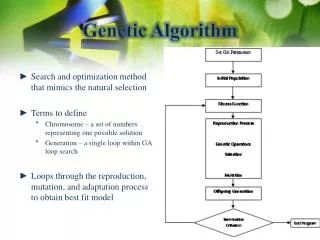
GA Flowchart START Initialization Selection Crossover Mutation No STOP? Yes END
Implementation • Encode • Decode
Implementation • Initialization • Use same encoding length for each variable • Randomly generate a population matrix (rand) • Round to nearest integer (round)
Implementation • Selection • Use objective value to measure fitness • Normalize fitness and use roulette wheel selection technique to select population for next generation • Keep the best individual to next generation
Implementation • Crossover • One-point Crossover Sourse: http://legacy.owensboro.kctcs.edu/gcaplan/anat2/notes/APIINotes2%20meiosis.htm
Implementation • Mutation • Bit String Mutation Sourse: http://www.ucl.ac.uk/~sjjgsca/DNAmutation.html
Settings • setting.txt
Results • Function