Understanding Significant Figures: Rules and Applications
110 likes | 246 Views
Discover the essential rules of significant figures that enhance precision in measurements. Significant figures are digits that carry meaningful information about the accuracy of values in scientific contexts. This guide succinctly outlines five key rules for identifying significant figures, including the treatment of non-zero digits, zeros between non-zero digits, and the importance of decimal points. Practice problems are provided to reinforce your understanding and application of these rules.


Understanding Significant Figures: Rules and Applications
E N D
Presentation Transcript
What are SIG FIG’S • Digits that carry meaning contributing to its precision. • They help make our “precision” more accurate • Precision-the degree to which repeated measurements under unchanged conditions show the same results.
HOW DO WE KNOW? 5 Simple Rules
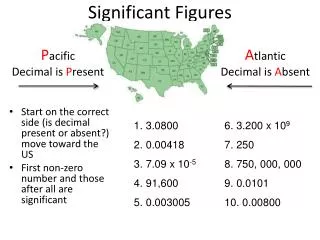
Rule #1 • All non-zeroes are significant • Ex: 123 has 3 sig figs 4789 has 4 sig figs 2 has 1 sig fig
RULE # 2 • All zeroes between non-zeroes are significant. • Examples: 70002 (5 sig figs) 7000200 (5 sig figs) 205 (3 sig figs)
RULE # 3 • All zeroes to the left of a decimal AND to the right of a non-zero are significant. Example: 7000200. (7 sig figs) 7000200 ( 5 sig figs) 120. (3 sig figs) 120 (2 sig figs)
RULE # 4 • All zeroes to the RIGHT of a decimal point AND to the right of a non-zero are significant. Examples: 7000200.0 (8 sig figs) 702.05 (5 sig figs)
Rule 5 All zeroes to the left of a non-zero are not significant. Examples: 0.00000072 ( 2 sig figs) 10.00000072 ( 10 sig figs)
CONFUSED? • Try the following problems for practice in your notes. Tell me how many sig figs there are and which rule or rules supports your answer.
PRACTICE PROBLEMS A.) 6.571 B.) 0.157 C.) 28.0 D.) 30.07 E.) 0.106 F.) 0.0067 G.) 26.509