Hydrates
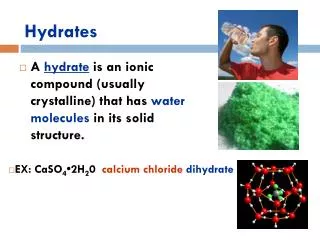
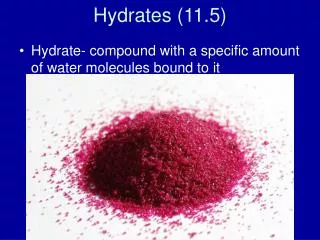
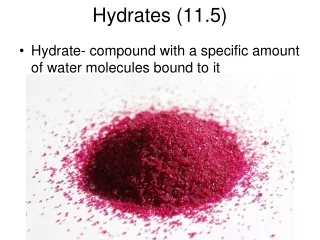
Hydrates are compounds that contain water molecules as part of their chemical structure. When writing chemical formulas for hydrates, it's essential to include the water content, represented by a dot (•) followed by the number of water molecules. For example, cobalt(II) chloride, CoCl2, can gain six water molecules, becoming CoCl2•6H2O, or cobalt(II) chloride hexahydrate. Conversely, when referring to the anhydrous form without water, we use "anhydrous" for compounds like CoCl2. Don't forget to add the mass of the water when calculating the molar mass of hydrates!

Hydrates
E N D
Presentation Transcript
Hydrates • Some substances, which we haven’t yet seen, are hydrates. • This means that they contain water within their chemical bonds. • Because of this, their chemical formulas must reflect the additional water. • To include “waters of hydration” in a chemical formula, simply add a dot (•) and put the number of water molecules after it. • Example next slide…
Hydrates • Example: CoCl2 is cobalt (II) chloride. However, there are many times when this compound gains six water molecules. • Therefore, we write the compound as CoCl2•6H2O • Its name is cobalt (II) chloride hexahydrate. • If it had five water molecules, it would be cobalt (II) chloride pentahydrate. You get the idea. • When describing a compound that is not hydrated, sometimes the term anhydrous is used. • Example: CoCl2 on its own is anhydrous cobalt (II) chloride.
Hydrates http://en.wikipedia.org/wiki/Hydrate
Hydrates: One Last Thing • When calculating molar mass (or formula mass) of a hydrate, add the mass of water to the rest of the formula’s mass. • I know it looks like a multiplication symbol, but don’t do that. That’d be bad .