Ultra-Low Power Time Synchronization Using Passive Radio Receivers
This work explores an ultra-low power universal time signal receiver that provides an efficient and low-cost solution for time synchronization in sensor networks. By leveraging RF time signals, specifically DCF77 and WWVB, this system offers high accuracy and small form factor while consuming minimal power. The design employs components like the CME6005 and PIC16LF1827, aimed at reducing overall power consumption while maintaining robust synchronization capabilities. Applications include synchronous MAC protocols and reduced latency in failure-prone sensor networks, offering advantages over traditional GPS systems.

Ultra-Low Power Time Synchronization Using Passive Radio Receivers
E N D
Presentation Transcript
Ultra-Low Power Time Synchronization Using Passive Radio Receivers Yin Chen†Qiang Wang* Marcus Chang† Andreas Terzis† *Dept. of Control Science and Engineering Harbin Institute of Technology †Computer Science Department Johns Hopkins University
Motivation • Message passing time synchronization • Requires the network be connected • Requires external time source for global synchronization • Is there a low-power and low cost solution?
Since half a century ago, we started to use RF time signals.
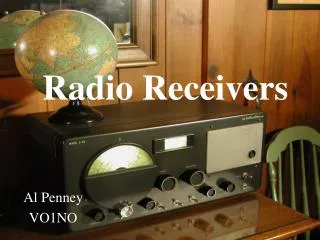
Current Day Time Sources Radio Controlled Clocks & Watches LF Time Signal Radio Stations This work will test DCF77 and WWVB
Contributions • Ultra-low power universal time signal receiver • Evaluations on time signals availability and accuracy in sensor network applications • Applications using this platform The antenna is 10 cm in length Smaller ones are available but we have not tested on our receiver
WWVB Radio Station • Located near Colorado, operated by NIST • Covers most of North America
WWVB Time Signal • 60 kHz carrier wave • Pulse width modulation with amplitude-shift keying • NIST claims • Frequency uncertainty of 1 part in 1012 • Provide UTC with an uncertainty of 100 micro seconds
WWVB Signal Propagation • Part of the signal travels along the ground • Groundwave : more stable • Another part is reflected from the ionosphere • Skywave : less stable • At distance < 1000 km, groundwave dominates • Longer path, a mix of both • Very long path, skywave only
WWVB Code Format • Each frame lasts 60 seconds • Each bit lasts 1 second 60 seconds 2010-5-24 06:11:00 UTC Marker bit Bit value = 0 Bit value = 1
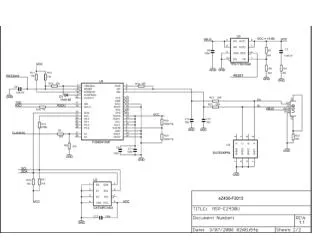
Time Signal Receiver Design • Requirements • Low power consumption • High accuracy • Low cost • Small form factor
Core Components • CME6005 • 40-120 kHz, can receive WWVB, DCF77, JJY, MSF and HBG • less than 90 uA in active mode and 0.03 uA when standby • PIC16LF1827 • 600 nA in sleep mode with a 32 KHz timer active • 800 uA when running at 4 MHz • Costs (as of 2010) • CME6005: $1.5 • PIC16LF1827: $1.5 • Antenna: $1 • Total: $4 Most of the time Reading bits & Writing to the uart Drop-in replacement of GPS Time in NMEA format & 1-pulse-per-second
Decoder Loop • Every second • MCU decodes the next bit from the signal receiver • Every minute • MCU decodes the UTC time stream • MCU sends the time stream to the uart
Experiment Configurations • Multiple motes, each connected to a receiver • One master mote • All motes are wired together • Master mote sends a pulse through a GPIO pin every 6 seconds • All motes timestamp this pulse as the synchronization ground truth • For WWVB, the distance is 2,400 km (indoor & outdoor), mainly sky wave • For DCF77, the distance is 700 km (indoor), mainly ground wave Near the edge of the coverage map
WWVB Outdoor WWVB Indoor DCF 77 Indoor
Accuracy • The differences of the time readings at the motes when the master mote sends the pulses Clock frequencies vary more in outdoor experiment
Comparison with FTSP • FTSP sync accuracy depends on resync frequency • Because clock frequency varies over time
Clock Frequency Variations Motes were placed together under a tree.
Power Consumption • What happens as sync interval T increases? • Schmid et al. observed that FTSP syncs in the millisecond range when using T = 500 seconds interval Time signal receiver Sync error in milliseconds range FTSP
Qualitative Observations • Steel frame buildings completely shield the time signal • Brick buildings allow signal reception • Laptops (when using AC power), oscilloscopes can easily interfere the time signal within a few meters • We used a portable logic analyzer connected to a laptop running on its battery
Applications • Synchronous MAC Protocols • Latency Reduction • Sparse Networks • Drop-in Replacement for GPS • Network-Wide Wakeup • Failure-Prone Sensor Networks
Synchronous MAC Protocols • Modify LPL • Sleep interval is divided into slots
Summary • Lower power consumption in the millisecond range • Support sparse networks • Provides an appropriate solution to the milliseconds and seconds range • GPS is an overkill • RTC drifts a few minutes per year even with temperature compensation
Signal Generator • 50 meters coverage