Mastering Recurrence Relations Theory
250 likes | 320 Views
Explore the concept of recurrence relations, solving examples, and applications. Understand how to find solutions, including linear homogeneous cases and nonhomogeneous cases with constant coefficients.


Mastering Recurrence Relations Theory
E N D
Presentation Transcript
Recurrence Relations Rosen 5th ed., §6.2 (c)2001-2003, Michael P. Frank
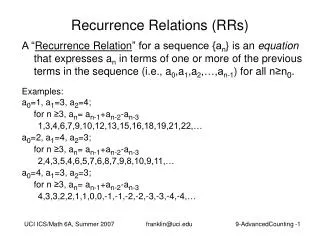
§6.1: Recurrence Relations • A recurrence relation (R.R., or just recurrence) for a sequence {an} is an equation that expresses an in terms of one or more previous elements a0, …, an−1 of the sequence, for all n≥n0. • A recursive definition, without the base cases. • A particular sequence (described non-recursively) is said to solve the given recurrence relation if it is consistent with the definition of the recurrence. • A given recurrence relation may have many solutions. (c)2001-2003, Michael P. Frank
Recurrence Relation Example • Consider the recurrence relation an = 2an−1 − an−2 (n≥2). • Which of the following are solutions?an = 3nan = 2n an = 5 Yes No Yes (c)2001-2003, Michael P. Frank
Example Applications • Recurrence relation for growth of a bank account with P% interest per given period: Mn = Mn−1 + (P/100)Mn−1 • Growth of a population in which each organism yields 1 new one every period starting 2 periods after its birth. Pn = Pn−1 + Pn−2 (Fibonacci relation) (c)2001-2003, Michael P. Frank
Solving Compound Interest RR • Mn = Mn−1 + (P/100)Mn−1 = (1 + P/100) Mn−1 = rMn−1 (let r = 1 + P/100) = r (rMn−2) = r·r·(rMn−3) …and so on to… = rnM0 (c)2001-2003, Michael P. Frank
Tower of Hanoi Example • Problem: Get all disks from peg 1 to peg 2. • Only move 1 disk at a time. • Never set a larger disk on a smaller one. Peg #1 Peg #2 Peg #3 (c)2001-2003, Michael P. Frank
Hanoi Recurrence Relation • Let Hn = # moves for a stack of n disks. • Optimal strategy: • Move top n−1 disks to spare peg. (Hn−1 moves) • Move bottom disk. (1 move) • Move top n−1 to bottom disk. (Hn−1 moves) • Note: Hn = 2Hn−1 + 1 (c)2001-2003, Michael P. Frank
Solving Tower of Hanoi RR Hn = 2 Hn−1 + 1 = 2 (2 Hn−2 + 1) + 1 = 22 Hn−2 + 2 + 1 = 22(2 Hn−3 + 1) + 2 + 1 = 23Hn−3 + 22 + 2 + 1 … = 2n−1H1 + 2n−2 + … + 2 + 1 = 2n−1 + 2n−2 + … + 2 + 1 (since H1 = 1) = = 2n − 1 (c)2001-2003, Michael P. Frank
§6.2: Solving Recurrences General Solution Schemas • A linear homogeneous recurrence of degree k with constant coefficients (“k-LiHoReCoCo”) is a recurrence of the forman = c1an−1 + … + ckan−k,where the ciare all real, and ck≠ 0. • The solution is uniquely determined if k initial conditions a0…ak−1 are provided. (c)2001-2003, Michael P. Frank
Solving LiHoReCoCos • Basic idea: Look for solutions of the form an = rn, where r is a constant. • This requires the characteristic equation:rn = c1rn−1 + … + ckrn−k, i.e., rk − c1rk−1 − … − ck = 0 • The solutions (characteristic roots) can yield an explicit formula for the sequence. (c)2001-2003, Michael P. Frank
Solving 2-LiHoReCoCos • Consider an arbitrary 2-LiHoReCoCo:an = c1an−1 + c2an−2 • It has the characteristic equation (C.E.): r2 − c1r − c2 = 0 • Thm. 1: If this CE has 2 roots r1≠r2, thenan = α1r1n + α2r2n for n≥0for some constants α1, α2. (c)2001-2003, Michael P. Frank
Example • Solve the recurrence an = an−1 + 2an−2 given the initial conditions a0 = 2, a1 = 7. • Solution: Use theorem 1 • c1 = 1, c2 = 2 • Characteristic equation: r2 − r − 2 = 0 • Solutions: r = [−(−1)±((−1)2 − 4·1·(−2))1/2] / 2·1 = (1±91/2)/2 = (1±3)/2, so r = 2 or r = −1. • So an = α1 2n + α2 (−1)n. (c)2001-2003, Michael P. Frank
Example Continued… • To find α1 and α2, solve the equations for the initial conditions a0 and a1: a0 = 2 = α120 + α2 (−1)0 a1 = 7 = α121 + α2 (−1)1 Simplifying, we have the pair of equations: 2 = α1 + α2 7 = 2α1 − α2which we can solve easily by substitution: α2 = 2−α1; 7 = 2α1 − (2−α1) = 3α1 − 2; 9 = 3α1; α1 = 3; α2 = 1. • Final answer: an = 3·2n − (−1)n Check: {an≥0} = 2, 7, 11, 25, 47, 97 … (c)2001-2003, Michael P. Frank
The Case of Degenerate Roots • Now, what if the C.E. r2 − c1r − c2 = 0 has only 1 root r0? • Theorem 2: Then,an = α1r0n + α2nr0n, for all n≥0,for some constants α1, α2. (c)2001-2003, Michael P. Frank
k-LiHoReCoCos • Consider a k-LiHoReCoCo: • It’s C.E. is: • Thm.3: If this has k distinct roots ri, then the solutions to the recurrence are of the form: for all n≥0, where the αi are constants. (c)2001-2003, Michael P. Frank
Degenerate k-LiHoReCoCos • Suppose there are t roots r1,…,rt with multiplicities m1,…,mt. Then: for all n≥0, where all the α are constants. (c)2001-2003, Michael P. Frank
LiNoReCoCos • Linear nonhomogeneous RRs with constant coefficients may (unlike LiHoReCoCos) contain some terms F(n) that depend only on n (and not on any ai’s). General form: an = c1an−1 + … + ckan−k + F(n) The associated homogeneous recurrence relation(associated LiHoReCoCo). (c)2001-2003, Michael P. Frank
Solutions of LiNoReCoCos • A useful theorem about LiNoReCoCos: • If an = p(n) is any particular solution to the LiNoReCoCo • Then all its solutions are of the form:an = p(n) + h(n),where an = h(n) is any solution to the associated homogeneous RR (c)2001-2003, Michael P. Frank
Example • Find all solutions to an = 3an−1+2n. Which solution has a1 = 3? • Notice this is a 1-LiNoReCoCo. Its associated 1-LiHoReCoCo is an = 3an−1, whose solutions are all of the form an = α3n. Thus the solutions to the original problem are all of the form an = p(n) + α3n. So, all we need to do is find one p(n) that works. (c)2001-2003, Michael P. Frank
Trial Solutions • If the extra terms F(n) are a degree-t polynomial in n, you should try a degree-t polynomial as the particular solution p(n). • This case: F(n) is linear so try an = cn + d. cn+d = 3(c(n−1)+d) + 2n (for all n) (−2c+2)n + (3c−2d) = 0 (collect terms) So c = −1 and d = −3/2. So an = −n − 3/2 is a solution. • Check: an≥1 = {−5/2, −7/2, −9/2, … } (c)2001-2003, Michael P. Frank
Finding a Desired Solution • From the previous, we know that all general solutions to our example are of the form: an = −n − 3/2 + α3n. Solve this for α for the given case, a1 = 3: 3 = −1 − 3/2 + α31 α = 11/6 • The answer is an = −n − 3/2 + (11/6)3n (c)2001-2003, Michael P. Frank