The skeletal System
The skeletal system is a vital framework that supports and shapes your body. Composed primarily of living bones, it serves five key functions: providing structure, protecting organs, facilitating movement through muscle attachment, producing blood cells, and storing essential minerals like calcium and phosphorus. Bones consist of compact and spongy structures, while joints allow for various types of movement. Key health issues like osteoporosis and arthritis highlight the importance of maintaining bone health. Explore the intricacies of this essential system for overall well-being.

The skeletal System
E N D
Presentation Transcript
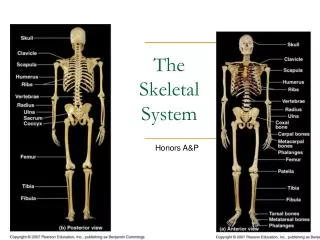
Functions of your skeletal system • The bones in your body are very much alive • Bones: main organs of the skeletal system; made of a form of connective tissue made up of bone cells surrounded by calcium and other minerals • There are five major functions of the skeletal system: • Gives shape and support • Protects internal organs • Major muscles are attached to bones and help them move • Blood cells are formed in the center of many bones • Major amounts of calcium and phosphorous compounds are stored in the skeleton for later use • Calcium and phosphorous make bones hard
Bone Structure • The surface of a living bone is covered with a tough, tight-fitting membrane • Under the membrane is a hard, strong layer called compact bone • Gives bone strength • Spongy bone is found in the ends of long bones • Has many small, open spaces that makes bones lightweight • The centers of long bones are filled with marrow • Some marrow is yellow and made up of fat cells • Red marrow makes two to three million red blood cells per second
Cartilage • The ends of bones are covered with a smooth, slippery, thick layer of tissue called cartilage • Does not contain blood vessels or minerals • Protects joints by acting as a shock absorber • Make movement easier because it lessens friction
Bone formation • Before you were born, your skeleton was made of cartilage • Over time, the cartilage was replaced by bone • At birth, your skeleton was made up of more than 300 bones • As you developed, some bones grew together so that you now have only 206 bones
Joints • Joint: any place where two or more of your bones come together • Bones are held in place at these joints by a tough band of tissue called a ligament • Immovable joint: allows little or no movement • Ex: the joints in the bones of your skull • Movable joint: required by all movement
Movable Joints • Pivot joints: one bone rotates in a ring of another bone that does not move • Ex: turning your head • Ball-and-socket joint: consists of a bone with a rounded end that fits into a cuplike cavity on another bone • Ex: your legs and arms • Hinge joint: has a back-and-forth movement like hinges on a door • Ex: elbow, knees, fingers • Gliding joints: one part of a bone slides over another bone • Ex: wrists, ankles, vertebrae
Potential problems • Osteoporosis: a condition in which bones become brittle and fragile from loss of calcium • Arthritis: the most common joint problem • All forms begin with the same symptoms: pain, stiffness, and swelling of the joints