Understanding Osteoporosis: Risks, Diagnosis, and Treatment Options
Osteoporosis is a condition marked by low bone mass and deterioration of bone tissue, affecting 25 million Americans. It leads to approximately 1.5 million fractures annually, with medical costs exceeding $10 billion. Risk factors include being post-menopausal, having a thin build, and a family history. Diagnosis is primarily through DEXA scans. Treatment focuses on increasing bone formation and decreasing bone loss through calcium and vitamin D intake, lifestyle changes, and medications. For more resources, visit the National Osteoporosis Foundation.

Understanding Osteoporosis: Risks, Diagnosis, and Treatment Options
E N D
Presentation Transcript
Osteoporosis Rockaway Townsquare Walkers Wednesday May 10, 2006 Rocco Simmerano, MD
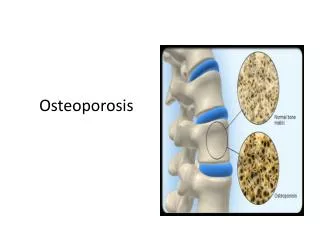
What is Osteoporosis? • Low bone mass, deterioration of bone tissue and bone fragility • Affects 25 million Americans • Results in 1.5 million fractures per year • Medical costs associated with osteoporosis exceed $10 billion dollars annually
How does it happen? • Balance between bone made and bone broken down • Too little bone mass at skeletal maturity • Too much bone loss after menopause BONE FORMATION BONE LOSS = Osteoporosis
Female Post-menopausal Family history Caucasian Over age 65 (men too) Thin build Estrogen deficiency Dietary factors Sedentary Smoking (past or present) Alcohol use Coffee or caffeinated beverages Risk Factors
Diagnosis • DEXA scan (dual-energy x-ray absorptiometry) • Measured against standard values • Measured in the hip and spine • < 1 standard deviation (SD) Normal • 1-2.5 SD Osteopenia • > 2.5 SD or fracture Osteoporosis • Lab tests
Who Should Be Tested? • Perimenopausal and postmenopausal women • Age > 65 (men and women) • Multiple risk factors • Anyone with a “fragility” fracture • Already being treated (to gage the effect of treatment)
Treatment BONE FORMATION • Increase Bone Formation BONE LOSS
Decrease Bone Loss Treatment BONE LOSS BONE FORMATION
Treatment for Men • Calcium—1,000 mg/day • Vitamin D—400-800 IU/day • Nutrition • Exercise • Impact • Strength • Balance
Treatment for Women • Same as for men • Medications • Hormones • Anti-bone loss • Fosamax • Bone forming agents • experimental
Resources • National Osteoporosis Foundation • 202-223-2226 • www.nof.org • National Institutes of Health Osteoporosis and Related Bone Diseases • 800-624-2663 • www.osteo.org