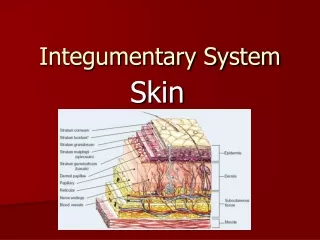
Integumentary System
Skin disorders, including various types of skin cancers and burns, pose significant health risks. Over a million cases of skin cancer are diagnosed annually, with Arizonians facing 3-7 times higher risks. The three common types include melanoma, basal cell carcinoma, and squamous cell carcinoma. Melanoma can be deadly, characterized by changes in moles and dark spots. Burns are classified by severity: 1st, 2nd, and 3rd degree, affecting different skin layers and requiring varied treatments. Awareness and early detection are crucial for effective management.


Integumentary System
E N D
Presentation Transcript
Integumentary System Ch. 5 Part 3
Skin Disorders • Cancer • Burns
Skin Cancers • Over 1 million diagnosed each year • Arizonan’s have 3-7x more risk than people in other states • 3 common types • Melanoma • Basal cell carcinoma • Squamous cell carcinoma
Melanoma • Most dangerous form of skin cancer • Appears as: • Change in existing mole • Small, dark multicolored spot with irregular borders, elevated or flat, bleed or form scab • Cluster of shiny, firm, dark bumps • Larger than a pencil eraser
Melanoma • Benign – not cancerous • Malignant - cancerous
Basal Cell Carcinoma • Come from cells in stratum basale of epidermis • Appear on sun-exposed skin as: • Pearly or flesh-colored oval bump with a rolled border, may develop into bleeding ulcer • Smooth red spot indented in center • Reddish, brown, or bluish black patch of skin on the chest or back
Squamous Cell Carcinoma • Arise from squamous cells of epidermis • Arise from damaged tissue • Appear on sun-exposed skin as: • A firm, reddish, wart-like bump that grows gradually • Flat spot that becomes a bleeding sore and won’t heal
Symptoms • Any change in size, color, shape or texture of a mole or other skin growth • Open or inflamed skin wound that won’t heal • ABCD’S of melanoma • A – asymmetry • B – border • C – color • D – diameter
Burns • 1st, 2nd, 3rd degree • Named according to severity • 1st degree • Least severe • Redness or discoloration • Swelling and pain • Usually overexposure to sun • Only epidermis is damaged
Burns • 2nd degree • Affect epidermis and dermis • May blister • Scarring may result • Most painful because nerves are intact but tissue is damaged • May involve loss of skin function
Burns • 3rd degree • Worst burn • May look white or charred • Extend through all skin layers – epidermis, dermis, subcutaneous layer • Severe to no pain depending on nerve damage • Requires skin grafts