Download
1 / 8
80 likes | 215 Views
This guide explains the essential rules of oxidation numbers, focusing on key principles integral to redox reactions. Key oxidation rules include that all pure elements have an oxidation number of zero, monatomic ions reflect their charges, and fixed oxidation states for certain elements. The material also covers how to calculate oxidation numbers in compounds, examines examples, and provides strategies for determining oxidation states in transition metals. Perfect for students preparing for chemistry regents exams.

E N D
Redox Reactions Nugent-Regents Chem
Oxidation Numbers: • Rule 1: All pure elements are assigned the oxidation number of zero. • Rule 2: All monatomic (single element) ions are assigned oxidation numbers equal to their charges. • Rule 3: Certain elements usually possess a fixed oxidation number in compounds. • The oxidation number of O in most compounds is -2. • The oxidation number of halogens in many, but not all, binary compounds is -1 • The oxidation numbers of alkali metals (Group I) and alkaline earth metals (Group II) are +1 and +2, respectively. • Rule 4: The sum of all oxidation numbers in a compound equals zero, and the sum of oxidation numbers in a polyatomic ion equals the ion’s charge.
Oxidation Numbers Practice: • All alone= 0: Pb = Pb0, O2= O20 • Given charge, Take Charge: Al+3 = +3 • Unless noted, sum charge =0 for ionic • AlCl3 = Al+3 and Cl-1
Transition Metals • Assign the non-metal, the one that carries a negative charge, its usual anion charge. (O = -2, Br = -1, etc.) • Set the net charge of the compound to equal zero. • Calculate the oxidation number needed to balance the total charge. • Example #2: What is the oxidation number of Cu in Cu3N2? • The oxidation number of N is -3. • There are 2 N atoms: (2)(-3) = -6 • The net charge is 0. • There are 3 Cu atoms: (3)(?) = +6 • Therefore, the oxidation state of Cu is +2.
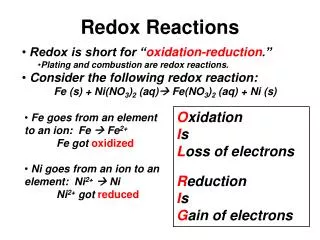
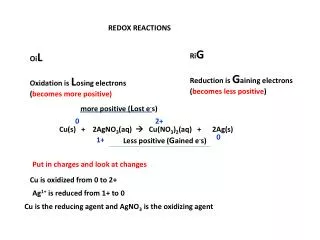
Redox • Redox Reactions: Transfer of electrons • Reduction: Gain of Electrons • Oxidation: Loss of Electrons • LEO the Lion says GER • OIL RIG • Law of Conservation of Mass and Charge!
Redox Animations • Zno + Cu+2 • Mgo + Cu+2
Assign ox #’s and balance CH4 + O2 CO2 + H2O ox: red: Mg + CoBr3 MgBr2 + Co ox: red:
Self Check • Quiz 1 • Self Check 2 • Self Check 3