What is Ecology?
160 likes | 285 Views
Ecology, derived from the Greek words "oikos" (household) and "logos" (study of), focuses on the interactions between living organisms and non-living components of their environment. This dynamic field examines factors such as light, water, soil nutrients, and climate, as well as the behavior and physiology of various species. It encompasses various levels of organization, from individual organisms to ecosystems, offering insights into how communities and populations interact. This presentation provides comprehensive knowledge essential for teaching and learning about our ecological systems.


What is Ecology?
E N D
Presentation Transcript
Origin of the word…”ecology” • Greek origin • OIKOS = household • LOGOS = study of… • Study of the “house/environment” in which we live.
Ecology is study of interactions between • non-living components in the environment… • light • water • wind • nutrients in soil • heat • solar radiation • atmosphere, etc. AND…
Living organisms… • Plants • Animals • microorganisms in soil, etc.
To study Ecology involves… • For living (biotic) • animal behavior • Taxonomy • Physiology • mathematics (population studies) • etc. • For non-living (abiotic) • Climatology • Hydrology • Oceanography • Physics • Chemistry • Geology • soil analysis, etc.
Ecology… • views each locale as an integrated whole of interdependent parts that function as a unit. caribou tundra
Nonliving • dead organic matter • nutrients in the soil and water. • Producers • green plants Tundra
Consumers • herbivores and carnivores • Decomposers • fungi and bacteria Tundra Caribou
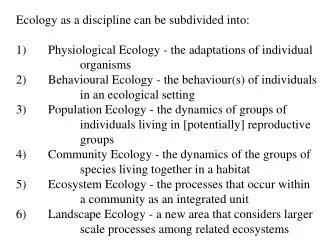
ECOLOGY: Levels of Organization - a hierarchy of organization in the environment
Levels of organization - Terms • Biosphere • Surface of the earth • Composed of many ecosystems • Ecosystem • Large or small as we decide • Backyard, O’Melveney Park, Hedge along Room 110, etc.
Levels of organization - Terms • Population – one species live in one place at one time • Community – All populations (diff. species) that live in a particular area.
Levels of organization - Terms • Habitat – physical location of community • Organism – simplest level of organization
Very complex • Can contain 100’s to 1000’s of interacting species.
THEN… Ecology is an integrated and dynamic study of the environment.
This powerpoint was kindly donated to www.worldofteaching.com http://www.worldofteaching.com is home to over a thousand powerpoints submitted by teachers. This is a completely free site and requires no registration. Please visit and I hope it will help in your teaching.