
Costs
E N D
Presentation Transcript
Today’s Lecture Structure • Definitions of cost and profit • Short run and long run • Different components of costs • Economies and diseconomies of scale
Costs and Profits • A basic assumption in economics is that the driving motive of business decisions is profit maximisation. Profits = total revenue - total costs • Economists and accountants measure profits in different ways
Costs and Profits • Total revenue: price x quantity • Costs are treated differently: • Explicit costs= payments to non-owners of a firm for the supply of their resources (wages paid to labour, costs of electricity, etc.) • Implicit costs= the opportunity costs of using the resources already owned by the firm, where no payment is made to outsiders (use of the factory, input of the owner / manager,…)
Economic Profits • Profit = total revenue - total opportunity cost or • Profit = total revenue - (total explicit costs + total implicit costs) • Economists refer to a zero economic profit as “normal profit “ (The minimum necessary to keep a firm in operation)
The short and the long run: a formal definition • The distinction between SR and LR depends on the ability to vary the quantity of inputs / resources used in production • Distinction between fixed & variable inputs • fixed inputscannot be changed during the period of time under consideration (e.g. physical capital assets) • a variable inputscan be changed during the period of time under consideration (e.g. labour)
The short and the long run: a formal definition So: • Short run:a period of time when there is at least one fixed input • Long run:a period of time when all inputs are variable
The production function: • A production function is a technical relationship between the maximum amount of output a firm can produce with their inputs:
A short run production function Output per day Quantity of labour • The relationship between the change in total output and labour is the marginal product of labour(i.e. by how much output goes up with an extra unit of labour - holding all other factors constant) • Hiring more workers increases output but not at a constant rate • The law of diminishing marginal returns states that beyond some point the marginal product decreases as additional units of a variable factor are added to a fixed factor.
Marginal product per day Quantity of labour Relation Between the Production Function and the Marginal Product of Labour Output per day Quantity of labour MPL
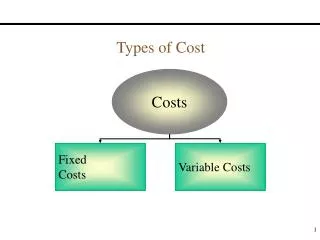
Short run costs • Total costs = total fixed costs + total variable costs • TC = TFC + TVC • Total fixed cost: costs that do not vary with output • Total variable cost: costs that vary as output changes
TC TVC TFC Total Cost Curves Cost Output
Average Costs • Average costs: costs per unit of output • Average fixed cost = TFC divided by quantity produced: AFC = TFC / Q • as output rises AFC falls continuously • Average variable cost = TVC divided by quantity produced: AVC = TVC / Q • usually average variable cost is U-shaped, with AVC falling initially and then rising as it becomes more costly to produce additional units of output. • Average total costs = AFC + AVC = TC/Q
ATC AVC AFC Average Costs Cost Output
Marginal Cost • Change in total costs due to a unit change in output Crucial! If the MC is less than the ATC, then the ATC must be falling. If the MC is more than the ATC, then the ATC must be increasing
MC Average and Marginal Costs Cost ATC Output
MC Average and Marginal Costs Cost ATC AVC Output
Long Run Production Costs • A firm operates in the short run when there is insufficient time to alter some fixed inputs • But…the firm plans in the long run, when all inputs are variable • The long run average cost (LRAC) traces the lowest cost per unit at which a firm can produce any level of output, after the firm builds any desired plant size
The LRAC Curve’ Cost SRATCl SRATCs SRATCm 40 30 Output 6 12 The plant size selected in the LR depends on the expected level of production
LRAC is tangent to the set of SRACs The LRAC with unlimited plant size Cost Output
Minimum efficient scale Economies of scale Cost Economies of scale Constant returns to scale Diseconomies of scale Output • LRAC varies from industry to industry • Usually economies of scale dominate diseconomies of scale