Download
1 / 11
120 likes | 260 Views
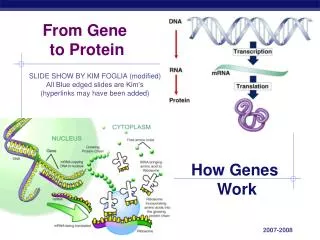
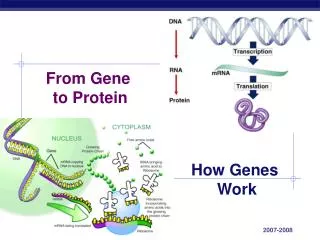
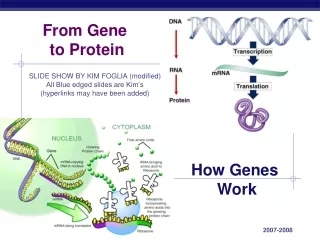
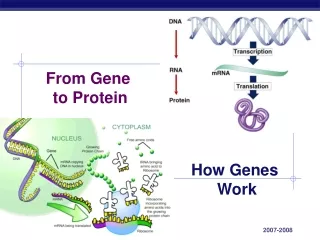
This overview explains the process of how genes are translated into proteins through transcription and translation. Transcription occurs in the nucleus where DNA is used as a template to create mRNA. This mRNA then travels to the cytoplasm, where translation takes place. During this phase, ribosomes interpret the mRNA sequence with the help of tRNA, which carries the appropriate amino acids, building proteins essential for cellular functions. Key concepts include the distinctions between DNA and RNA, and the importance of codons in assembling amino acid chains.

E N D
Proteins directly Not • are built transfer info • from genes. DNA the to RNA • another nucleic acid called . Picture complements of www-ics.u-strasbg.fr/~etsp/lecture/mbio/glos.php
Types of RNA Messenger RNA, carriers and delivers the info from DNA • mRNA - • tRNA - TransferRna, helps ribosomes read mRNA by bringing “AA”
Two Main Processes • - which is when gets Transcription mRNA DNA • information from . Translation • - when a ribosome reads mRNA • in order to make an Amino Acid (AA) chain • which makes up a protein.
Where it Occurs. Transcription • - is a process that occurs in the nucleus.
Transcription • - enzyme unwinds DNA and uses one strand as a template to make RNA RNA Polymerase
Where it Occurs. • - occurs in the cytoplasm. Translation
tRNA 3 1 • bases = Amino Acid(s) (AA) which is called a codon. Amino acid ____ tRNA anticodon
Translation MET ____ ribosome E P A U A C U C A C C A G U A U G G A A anticodon m RNA