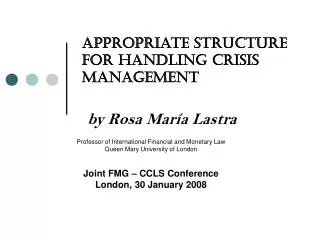
Appropriate structures for handling crisis management
170 likes | 274 Views
Explore appropriate structures for crisis management by analyzing financial stability functions and institutions. Learn about liquidity management, market liquidity, insolvency management, and existing arrangements.


Appropriate structures for handling crisis management
E N D
Presentation Transcript
Appropriate structures for handling crisis management Willem H. Buiter Professor of European Political Economy, European Institute, London school of Economics and Political Science Presentation prepared for the FMG/CCLS London Financial Regulation Seminar The Regulatory Response to the Financial Crisis, 30 January 2008, 2-6 pm, Derek Willoughby Lecture Theatre, Charterhouse Square EC1
Financial stability: the dogs that should not bark • Monetary policy (setting short risk-free nominal interest rate (operationally the target for the overnight interbank rate) • dedicated to achieving inflation target (& subject to that growth, employment etc.) • No material role in financial stability or liquidity management • Fiscal policy (public spending & taxes) • no material role in financial stability management other than through insolvency management for banks (& ofis?)
Financial stability: functions • Liquidity management • Funding liquidity (property of agents/institutions) • Discount window (when there are no solvency concerns; on demand) • Eligible liquid & illiquid collateral, valuation, haircuts • Maturity • Eligible counterparties • Penalty rate • LoLR (when there are solvency concerns as well as illiquidity; discretionary & ad-hoc) • Eligible illiquid collateral, valuation, haircuts • Maturity • Penalty rate • Other penalties
Financial stability: functions • Market Liquidity (property of instruments/markets) • Regular open market operations (outright purchases or repos) involving liquid securities • Eligible liquid securities/collateral; haircuts • Maturity • Eligible counterparties • MMLR operations (outright purchases or repos) involving illiquid assets • Eligible illiquid securities/collateral; valuation, haircuts • Maturity • Eligible counterparties • Penalty rate (?)
Financial stability: functions • Insolvency management • Special insolvency regime for failing banks (& ofis?) • ‘Prompt corrective action’ • Quantitative/objective or qualitative/subjective triggers • ‘Bridge bank’; takes over & runs failing institution; ringfences deposits & can transfer them to third party • Deposit insurance • Industry-funded or taxpayer-funded • Pre-funded or funded ex-post
Financial stability: functions • “Covert operations” • Secrecy for assistance by Authorities during short-term windows of vulnerability (e.g. time it took for SocSec to arrange a capital subscription) • Find ‘private sector solution’ for troubled/failing bank (problem with Takeover Code). • Provide secret LoLR assistance (alleged problem with EU Market Abuse Directive & its transposition into UK law/rules is spurious).
Financial stability: institutions • Central bank (Bank of England) • Regulator/Supervisor (FSA) • Ministry of Finance (Treasury) • Deposit insurance agency (Financial Services Compensation Scheme) • Bank insolvency management agency (NADA)
Existing arrangements • Inadequate deposit insurance (co-insurance, delays, limit) • No special bank insolvency resolution regime • Tripartite arrangement
The current Tripartite arrangement • Why did it fail? • Failure to announce deposit guarantee when Liquidity Support Facility for NR was announced. • Failure to speak with one voice • Information required for provision of funding liquidity to individual banks (FSA) institutionally separate from short-term deep pockets (BoE) & long-term non-inflationary deep pockets (Treasury) • Long list of idiosyncratic failures (Northern Rock reckless, FSA asleep, BoE late to own up to responsibility for market liquidity, Treasury dithering)
Can opener • Assume we have an efficient deposit insurance scheme and insolvency resolution scheme for banks (& possibly systemically important ofis). • Deposit insurance and insolvency resolution scheme for banks best put with the same agency • That agency should probably be the FSA, financially backed by the Treasury, but could be a separate agency • DI cannot be funded (ex-ante or ex-post) by participating institutions when there is a systemic run on the banking sector • Note, with adequate DI & IRS, no need for Covert Operations B and C (see slide 6.)
Why the Treasury Committee’s proposal won’t work • Authority relationship between Deputy Governor of BoE/Head of Fin Stab and Governor of BoE unclear • LoLR role too political to be compatible with MPC operational independence for monetary policy • Partial solution: take Deputy Governor of BoE/Head of Fin Stab off MPC (suggested in Treasury Cttee Report). • Radical solution: take MPC out of BoE • Make Governor of BoE head of Fin Stab • Governor of BoE no longer Chair of MPC? • Governor of BoE no longer member of MPC? • BoE Agent of MPC for targeting overnight interbank rate (would require change in money market operating procedures – ‘pegging’ the repo & reverse repo rates instead of the current attempts to fix both P & Q)
Minimalist Monetary Authority Proposal • Give Monetary Authority responsibility for • Deciding and setting Bank Rate • Managing market liquidity • Regular OMOs • Market Maker of Last Resort • Managing funding liquidity only through the discount window (standing lending facility) • Make Regulator LoLR, through an open-ended, uncapped credit line with the BoE, guaranteed by the Treasury
The Tripartite Arrangement with a minimalist central bank 15
How to handle troubled bankswhen there is effective depositinsurance & Is bank illiquid? Yes No Be happy! Is bank insolvent? Yes Is bank systemically important? No Don't know Yes No Bank fails Special LoLR credit line with FSA (& MMLR) Go to FSA special insolvency regime (nationalisation) OMOs & MMLR & Discount Window with BoE 16