Cell Reproduction
This resource explores the fundamental differences in cell reproduction between prokaryotes (like bacteria) and eukaryotes (plants and animals). Prokaryotes reproduce via binary fission, a simple process that allows for quick replication. In contrast, eukaryotes undergo a more complex mitotic division involving several distinct phases: G1, S, G2, and M phases, resulting in two daughter cells. Key steps in mitosis are highlighted, including prophase, metaphase, anaphase, and telophase, along with cytokinesis, showcasing the efficient and structured nature of eukaryotic cell division.

Cell Reproduction
E N D
Presentation Transcript
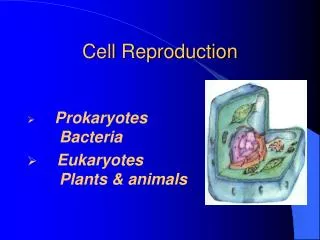
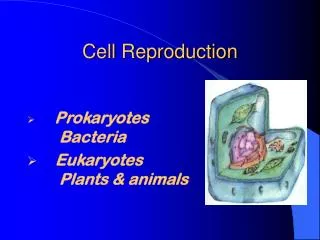
Cell Reproduction • Prokaryotes Bacteria • Eukaryotes Plants & animals
Prokaryotes • Lack a nucleus • Have a single chromosome • Reproduce by binary fission • Include bacteria
Steps in Binary Fission • Used by bacteria • Cells increase their cell mass slightly • DNA & cell components are replicated • Each cell divides into 2 daughter cells
Eukaryotes • Contain a nucleus & membrane bound organelles • Asexually reproduce cells by mitosis
Cell Cycle • Stages in growth & division • G1 Phase • S Phase • G2 Phase • M Phase • Cytokinesis
G1 Phase • First growth stage • Cell increases in size • Cell prepares to copy its DNA
Synthesis Phase • Copying of all of DNA’s instructions • Chromosomes duplicated
G2 Phase • Time between DNA synthesis & mitosis • Cell continues growing • Needed proteins produced
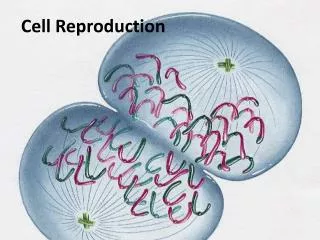
M Phase • Cell growth & protein production stop • Cell’s energy used to make 2 daughter cells • Called mitosis or karyokinesis (nuclear division)
Life Cycle of a Cell Mitosis is a cycle with no beginning or end.
Interphase – Resting Stage • Cells carrying on normal activities • Chromosomes aren’t visible • Cell metabolism is occurring • Occurs before mitosis
Stages of Mitosis • Prophase • Metaphase • Anaphase • Telophase
Steps in Prophase • DNA coils tightly & becomes visible as chromosomes • Nuclear membrane disappears • Nuceolus disappears • Centrioles migrate to poles • Spindle begins to form
Steps in Metaphase • Spindle fibers from centrioles attach to each chromosome • Cell preparing to separate its chromosomes • Cell aligns its chromosomes in the middle of the cell
Steps in Anaphase • Cell chromosomes are separated • Spindle fibers shorten so chromosomes pulled to ends of cell
Steps in Telophase • Separation of chromosomes completed • Cell Plate forms (plants) • Cleavage furrow forms(animals) • Nucleus & nucleolus reform • Chromosomes uncoil
Telophase Plant Animal
Cytokinesis • Occurs after chromosomes separate • Forms two, identical daughter cells
Cytokinesis Cell Plate Forming in Plant Cells