Download
1 / 27
270 likes | 392 Views
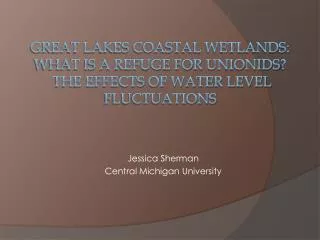
J essica Sherman Central Michigan University. Great lakes coastal wetlands: What is a refuge for unionids ? T he effects of water level fluctuations. Introduction. Jessica Sherman B.S. in Biology and Pre-Veterinary Medicine from the University of Findlay

E N D
Jessica Sherman Central Michigan University Great lakes coastal wetlands: What is a refuge for unionids?The effects of water level fluctuations
Introduction • Jessica Sherman • B.S. in Biology and Pre-Veterinary Medicine from the University of Findlay • Currently at CMU for M.S. in Conservation Biology • Advisor: Don Uzarski • Committee: Dave Zanatta, DaelynWoolnough, and Brent Murry
Objectives • Locate refuge populations of unionids in Great Lakes coastal wetlands • Measure chemical and physical parameters • Determine if any support unionids or inhibit dreissenid colonization
Methods • Project began in early June • Initial set up phase • Sites revisited at six and 12 weeks • Inner and outer wetland surveyed • Emergent stem densities
Grand Traverse Bay Study Sites
Methods • Water Quality Measurements • Multiparameter Water Quality Sonde • Water gauges
Methods • Water Quality Measurements • Multiparameter Water Quality Sonde • Water gauges
Methods • Dreissenid Colonization • Unglazed clay tiles • 16x16 cm
Methods • Unionid Surveys • Initial 1 p-h visual search for live mussels • Staked location • Snorkeled searches
Methods • Unionid Surveys • Initial 1 p-h visual search for live mussels • Staked location • Snorkeled searches • Except… • North Maumee Bay
Methods • Unionid Surveys • Clam rake surveys • Haphazard starting location
Results • Live Unionids found • Les Cheneaux Islands • 1 species • 100% fouled • Lake St. Clair Delta • 10 species • 85% fouled • North Maumee Bay • 2 species • 50% fouled
The Les Cheneaux Islands Lake St. Clair Delta = Unionids present = Unionids absent North Maumee Bay
Results • Dreissena colonization on tiles only at Saginaw Bay and North Maumee Bay • Highest 20,741 and 31,007 per m2 , respectively • Present in open water of all sites studied • Saginaw Bay historically contained 13 unionid species Ricciardi et al. 1995, Goodrich and Vander Schalie 1932
Saginaw Bay Results 5,087 per m2 46 per m2 = No colonization = Colonization 20,741 per m2 North Maumee Bay 821 per m2 31,007 per m2 0 per m2 * Highest Recorded Dreissenid Colonization Outer wetland higher than inner
Results 18.5% 28%
Conclusions • Physicochemical variables in Saginaw Bay & North Maumee Bay appear to support Dreissena colonization • Low productivity could inhibit Dreissena colonization • No correlations between unionid populations and physicochemical factors