The Skeletal System
130 likes | 154 Views
Discover fascinating facts about the skeletal system! Learn about bone terminology, the different parts of the skeleton, functions of bones, and the classification of bones by shape.


The Skeletal System
E N D
Presentation Transcript
The Skeletal System NO BONES ABOUT IT! Did you know? The adult skeleton has 206 bones
Terminology: Oste “bone” Art “joint” -blast “germ” or embryonic (creating/producing) -clast “broken” (destroying/break down) -cyte “cell” Peri- “around” Dia- “between or across” Epi- “upon” Hemat- “blood”
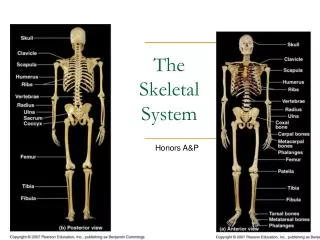
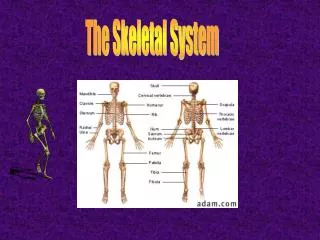
The Skeletal System Parts of the skeletal system • Bones (skeleton) • Joints (flexibility) • Cartilages (cushion) • Ligaments (connect bone to bone)
Functions of Bones • Support the body (internal framework) • Protect soft organs (vertebrae) • L • Allow movement due to attached skeletal muscles • Store minerals and fats (fats, calcium, phosphorus) • Hematopoiesis (Blood cell formation)
Two subdivisions of the skeleton 1. Axial skeleton (skull, ribs, spine) 2. Appendicular skeleton (pectoral girdle, pelvic girdle, bones of limbs)
Head • Long bones Have a shaft with heads at both ends • Typically longer than they are wide • Contain mostly compact bone • Examples: • Femur (longest bone in the body) Shaft Head Figure 5.1a
Anatomy of a Long Bone • Diaphysis • Compact bone • Protected by periosteum (membrane) • Epiphysis • Ends of the bone • Thin layer of compact bone • But mainly spongy bone in the middle • Protected by articular cartilage
Anatomy of a Long Bone • Medullary cavity • Cavity inside of the diaphysis • Contains yellow marrow (mostly adipose) in adults • Contains red marrow (for blood cell formation) in infants
2. Short bones • Generally cube-shape • Contain mostly spongy bone Example: • Carpals • Tarsals Figure 5.1b
3. Flat bones • Thin, flattened, and usually curved • Two thin layers of compact bone inside • Layer of spongy bone inside Example: • Skull • Ribs • Sternum
4. Irregular bones • Irregular shape • Do not fit into other bone classification categories • Example: • Vertebrae • Hip bones
5. Sesmoid bones • Develop in some tendons where there is considerable friction, tension, and physical stress • Only one found in all normal human skeletons • Example: • Patella