Comprehensive FL VoIP Simulation Setup and Parameters Analysis
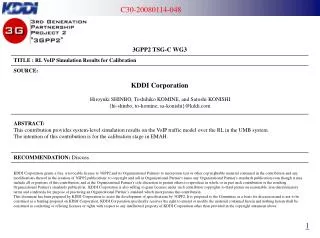
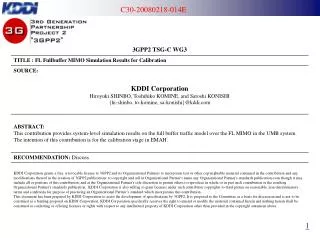
This document outlines the complete setup for FL VoIP simulations, adhering to the criteria set in parameter spreadsheets C30-20080114-029 and C30-20080114-021. It includes effective SNR AWGN curves and models such as Ped-B and Veh-A for channel analysis. Key parameters include a 100ms transmission deadline and a scheduler in sync with C30-20071025-006. The simulations cover various metrics, including throughput, PER distribution, HARQ statistics, and VoIP packet latency for both 3 km/h and 120 km/h scenarios. This extensive analysis aids in optimizing VoIP performance under diverse conditions.

Comprehensive FL VoIP Simulation Setup and Parameters Analysis
E N D
Presentation Transcript
Simulation Setup • FL VoIP simulation • All the parameters and methods for the simulations follow both the parameter spread sheet in C30-20080114-029 and the output metrics spread sheet in C30-20080114-021 • Notes: • Effective SNR AWGN curves (C30-20080114-029) is used. (Note that the PER curves for 8 tiles are used.) • AWGN channel and ITU Model (Ped-B and Veh-A) as the channel model • BRCH for F-DCH • AT Layout: C30-20080114-030 (Newly updated by QCOM • Parameters: C30-20080114-019 • Scheduler: in line with the pseudo code in C30-20071025-006 • Transmission Deadline (at BS) of 100ms • Bin width for the statistics in the following figures • Throughput: 10kbps, Geometry: 0.25dB, PER: 0.01 • Note: the value in the x-axis represents the central value in a bin
Ped-B 3km/h channel • Aggregate sector throughput (Optional)
Ped-B 3km/h channel • PER distribution
Ped-B 3km/h channel • HARQ statistics (distribution)
Ped-B 3km/h channel • 98% VoIP packet latency CDF
Ped-B 3km/h channel • Load (Tile occupancy) CDF
Ped-B 3km/h channel • CDF of AT VoIP packet jitter (Optional)Note: This graph is made from the average jitter of AT.
Veh-A 120km/h channel • Aggregate sector throughput (Optional)
Veh-A 120km/h channel • PER distribution
Veh-A 120km/h channel • HARQ statistics (distribution)
Veh-A 120km/h channel • 98% VoIP packet latency CDF
Veh-A 120km/h channel • Load (Tile occupancy) CDF
Veh-A 120km/h channel • CDF of AT VoIP packet jitter (Optional)Note: This graph is made from the average jitter of AT.
Appendix ~ Output Metrics Spread Sheets ~ • Ped-B 3km/h channel • Veh-A 120km/h channel