Download
1 / 13
130 likes | 246 Views
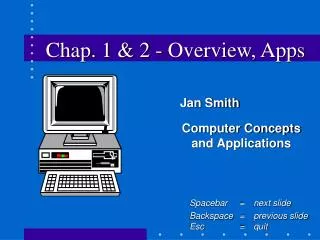
This presentation provides a comprehensive review of computer basics, emphasizing the fundamental operations of computers: accepting input, processing data, producing output, and storing results. It explores the information processing cycle and discusses why computers are powerful devices, particularly due to their speed, reliability, and storage capabilities. The categories of computers—personal, mini, mainframe, and supercomputers—are detailed, highlighting their distinctive features, usage, and the environments designed to support them.

E N D
Chap. 1 & 2 - Overview, Apps Jan Smith Computer Concepts and Applications Spacebar = next slide Backspace = previous slide Esc = quit
Covering: • Review of chapter 1 - Overview
Chapter 1 - Overview A computer is an electronic device that: a. operates under the control of memory unit b. accepts data c. processes data d. produces output e. stores the results for use later
Chapter 1 - Overview b. accepts data c. processes data d. produces output e. stores the results for use later Information Processing Cycle Input Processing Output Storage
Why is a computer powerful? • Speed billions of actions per second • Reliability failures usually human error • Storage keepshuge amounts of data
Categories of Computers • Personal or micro • Mini • Main Frame • Super
Categories of Computers Personal = micro Portable Types: Hand-held Palmtop Notebook Subnotebook Laptop Pen
Categories of Computers Personal = micro Portable Types: Hand-held Palmtop Notebook Subnotebook Laptop Pen Desktop
Categories of Computers Personal = micro Portable Types: Hand-held Palmtop Notebook Subnotebook Laptop Pen Desktop Tower
Categories of Computers Personal = micro Portable Types: Hand-held Palmtop Notebook Subnotebook Laptop Pen Desktop Tower Workstations
Categories of Computers Servers (how it’s used more than what it is) Designed to support a computer network More powerful Larger memory Larger storage capacity High speed communications
Categories of Computers Minicomputers Originally for specific tasks, like engineering calculations Main frame Large systems for hundreds of users Requires special environment
Categories of Computers Supercomputers Most powerful category Used for weather forecasting, engineering design and testing, serious decryption Cost several million dollars