Download

1 / 6
70 likes | 189 Views
Discover essential strategies for integrating rational functions using partial fractions. Begin with anti-differentiation and explore u-substitution and inverse trig forms. Encountering extra variables? Complete the square. Learn to apply integration by parts and recognize common forms. We cover three cases for partial fractions: distinct factors, repeating factors, and irreducible quadratics. If the numerator's degree exceeds the denominator's, use long division first. These techniques will empower you to tackle complex integrals with confidence!

E N D
7.4 Partial Fractions We integration!
Tips for Integration • Try anti-differentiation first • Try u-substitution • Check for Inverse trig forms • If there is an extra variable in the denominator, try completing the square • Integration by Parts • Check for the common forms • Integration by Partial Fractions • Try 1 of the 3 cases • Use Algebra! • Don’t be afraid to mix multiple techniques in 1 problem!
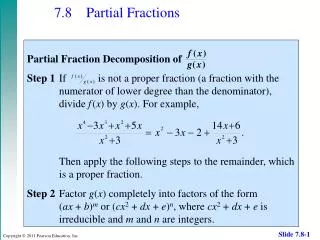
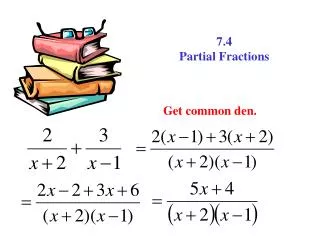
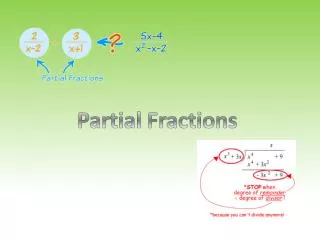
3 Cases for Partial Fractions • Case I – The denominator has distinct factors • Case II – The denominator has repeating factors • Case III – The denominator has a quadratic that won’t factor • If the degree in the numerator is higher than the degree in the denominator, use long division first.
Case III – The denominator has a quadratic that won’t factor