Download
1 / 2
20 likes | 138 Views
This comprehensive overview explores the unique physical features and processes that define the Arctic region. It delves into the interactions among crucial system elements, including the atmosphere, oceans, sea ice, and land formations like tundra and boreal forests. The impact of climate change, both global and regional, is examined alongside natural and human-induced variability. Additionally, the atmospheric structure, circulation dynamics, and energy balance within the Arctic are discussed, highlighting the importance of snow and ice research in understanding the Arctic's role in global climate systems.

E N D
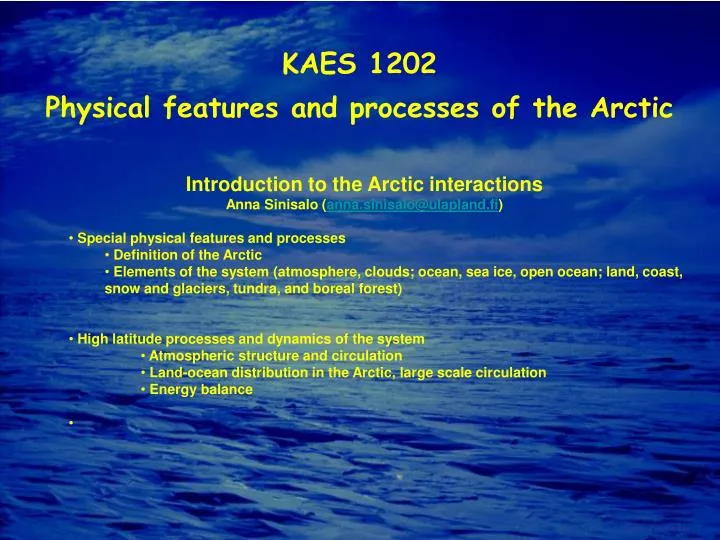
Photo: Eija Kärkäs KAES 1202 Physical features and processes of the Arctic • Introduction to the Arctic interactions • Anna Sinisalo (anna.sinisalo@ulapland.fi) • Special physical features and processes • Definition of the Arctic • Elements of the system (atmosphere, clouds; ocean, sea ice, open ocean; land, coast, snow and glaciers, tundra, and boreal forest) • High latitude processes and dynamics of the system • Atmospheric structure and circulation • Land-ocean distribution in the Arctic, large scale circulation • Energy balance
Photo: Eija Kärkäs KAES 1202 Physical features and processes of the Arctic • Introduction to the Arctic interactions • Anna Sinisalo (anna.sinisalo@ulapland.fi) • Global and regional climate change • Greenhouse effect • Natural variability (Milancovich, oscillations ?) • Human induced variability • ACIA report • Snow and terrestrial ice • Distribution • Role (cooling effect, sea level, etc. • Snow and ice research • Glacial cycles?