Advanced SANS Techniques for Characterizing Nanoporous Ni-base Superalloy CMSX4
This study explores high-resolution Small Angle Neutron Scattering (SANS) to characterize nanoporous materials derived from the Ni-base superalloy CMSX4. Key techniques include self-assembly of γ’ precipitates and selective phase dissolution via electrochemical etching to create fine porosity. Applications range from separation processes to gas-permeable membranes. We investigate pore evolution over various etching times, highlighting saturation effects. Our findings demonstrate optimal etching conditions for enhancing porous structures, contributing to advancements in material science and engineering.

Advanced SANS Techniques for Characterizing Nanoporous Ni-base Superalloy CMSX4
E N D
Presentation Transcript
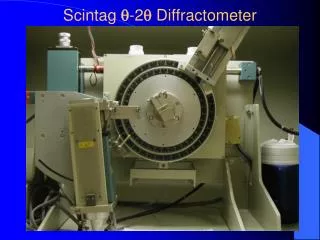
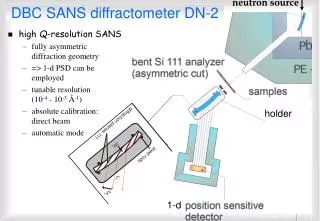
neutron source DBC SANS diffractometer DN-2 • high Q-resolution SANS • fully asymmetric diffraction geometry • => 1-d PSD can be employed • tunable resolution (10-4 - 10-3 Å-1) • absolute calibration: direct beam • automatic mode holder 1-d
Characterizing nanoporous material from Ni-base superalloy CMSX4 NPL_1007: R. Gilles (TU Muenchen), D. Mukherji (TU Braunschweig), local contact P. Strunz • 1. self-assembly of γ’ precipitates in superalloys during thermo-mechanical exposure – rafting • 2. selective phase dissolution using electrochemical etching • => nanoporous material (fine open porosity, regularity) • Prospective applications: separation processes, catalytic substrate, miniature heat exchangers, gas permeable membranes • fabrication optimization (electrolyte, mode, potential): the pore-depth dependence on the etching time? Saturation (increasingly difficult transport)? • Technique: high-resolution SANS
Etching time 0 h 4 h 6.5 h 14 h 48 h SANS for galvanostatic etching Depth evolution with time white: γ-phase; gray: γ'-precipitates; black: pores Models (optimum fit) • The depth evolution with etching time determined • The galvanostatic mode of γ-phase dissolution visibly faster • Dissolution very significantly decelerated approximately after 24 hours of the galvanostatic etching (saturation at ≈330 μm) • Pore volume fraction increase (due to <100% selectivity of etching) For details see: P.Strunz, D.Mukherji, O.Näth, R.Gilles, J.Rösler, Physica B (2006) 385, 626-629