Understanding Wave Superposition, Harmonics, and Frequency Relationships in Sound
This article explores the principles of wave superposition, harmonics, and the resulting frequencies in sound. It examines how combining frequencies leads to perceived pitch and introduces the concept of the Greatest Common Factor (GCF) in determining resultant frequencies. Key topics include the beat frequency, the significance of harmonics in sound synthesis, and detailed analysis of various waveforms such as sawtooth and square waves. The content is aimed at students and enthusiasts eager to understand the complex interplay of sound waves and their effects.

Understanding Wave Superposition, Harmonics, and Frequency Relationships in Sound
E N D
Presentation Transcript
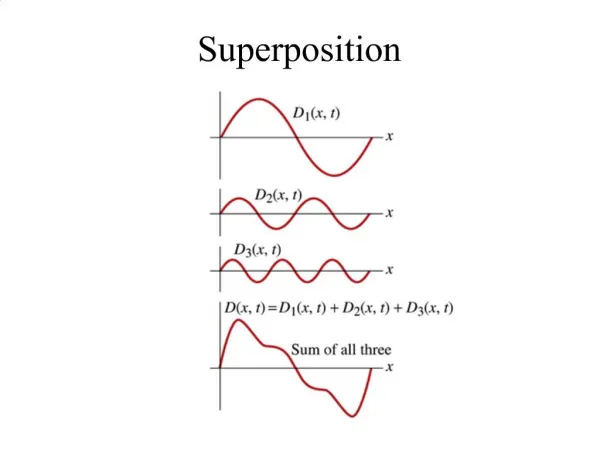
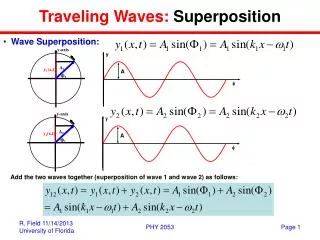
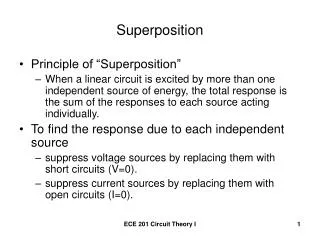
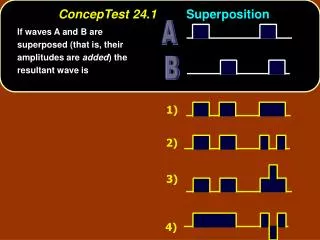
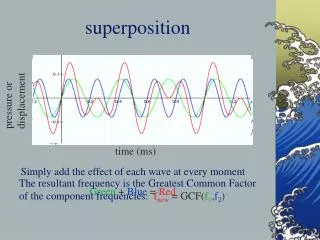
Simply add the effect of each wave at every moment Green + Blue = Red superposition pressure or displacement time (ms) The resultant frequency is the Greatest Common Factor of the component frequencies:fnew = GCF(f1,f2)
Beating f1= 5 f2= 5.5 fcomb= .5 f1= 20 f2= 21 fcomb= 1 The beat frequency is the difference of the component frequencies f1= 500 f2= 501 f1= 500 f2= 505 f1= 500 f2= 510
Harmonics What is the greatest common factor of... (10, 20, 30, 40, ...)? (150, 300, 450, 600, ...)? (440, 880, 1320, 1760, ...)? perceived pitch is always the fundamental frequency f1 fundamental 2nd harmonic f2 = 2 f1 3rd harmonic f3 = 3 f1 4th harmonic f4 = 4 f1
Superposition of many harmonicssawtooth wave f +2f (A2 = 1/2) f =500 Hz (A = 1) f +2f +3f (A3 = 1/3) f +2f +3f+4f+5f (A5 = 1/5) 10 harmonics
Superposition of many sine wavessquare wave f =500 Hz (A = 1) f +3f (A3 = 1/3) f +3f+5f (A5 = 1/5) f +3f+5f+7f+9f (A9 = 1/9) 10 harmonics
A sound is the sum of its parts Piano Fundamental only Harmonics 1 & 2 Harmonics 1, 2, 3 Harmonics 1-4 Harmonics 1-5 Harmonics 1-6 Full sound