Download
1 / 21
210 likes | 329 Views
This document outlines the challenges faced by the Greek School Network regarding direct LDAP writes and the transition to using web services for enhanced functionality. It discusses the advantages of web services, including improved user management, centralized logging, and schema flexibility. With over 170,000 entries, the document also highlights the existing e-school environment and its associated services, emphasizing the importance of a user-friendly interface and the benefits of a web service-driven architecture for administrative tasks and user management.

E N D
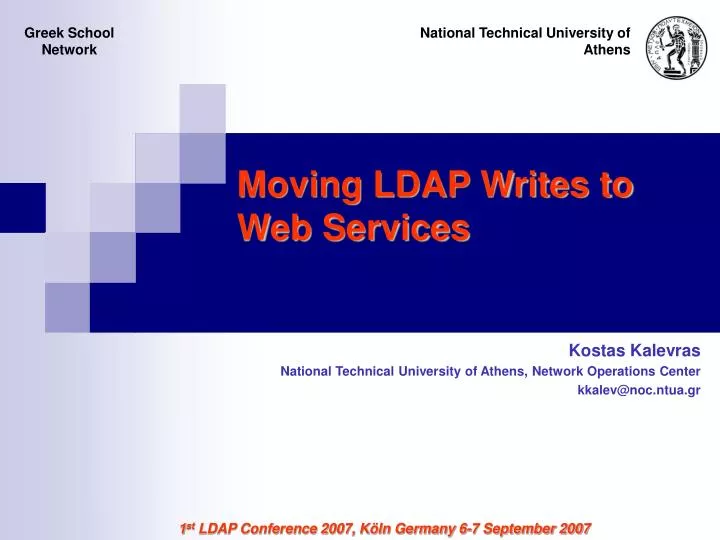
Greek School Network National Technical University of Athens Moving LDAP Writes to Web Services Kostas Kalevras National Technical University of Athens, Network Operations Center kkalev@noc.ntua.gr
Agenda • Greek School Network – E-School Development Environment • Problems with direct LDAP writes • Why move to Web Services • LDAP Reads – Authentication • LDAP User Management Service PHP API • Conclusion
Greek School Network • Interconnects all Greek schools and provides Internet access • Provides school and personal accounts • Email, Dialup, VoIP, web pages services
LDAP Service • Based on Sun One Directory Server • Central authentication repository for all user services • Contains the Organizational Hierarchy • 170,000 entries • School accounts, teacher accounts • Student accounts scheduled
User Administration • Central Web-based interface • Written in PHP and Javascript • Provides an object and form editor/creator • One form is created per object type (object types are abstract types like student, teacher, adsl router, etc) • LDAP tree browser and data manipulation (add, edit) forms are provided to administrators • Delegated administration of entries
Interface features • Computed attributes based on other attribute values • Computation formula: Any valid PHP expression or even function • Attribute uniqueness • Referential integrity • Post operations (moving user home directories, welcome emails, etc)
E-School framework • Services on top of the current network • Provided services: • Web portal (sPortal) for student parents • Parents register and can check out their child’s progress and status • PKI infrastructure • School Administration platform • Move all school operations to the electronic world (student enrollment, classroom management, grading) • Central personnel and student database • Interface (.NET) running on all schools communicates changes with the central database
New entry sources • Old days: Accounts were created through the central web interface • E-School: Accounts are created from more than one sources now: • sPortal creates parent accounts • School Administration platform creates teacher, student accounts and maintains the organizational hierarchy • School accounts (official school email account) still need to be created ‘by hand’
Why Direct LDAP access is bad • Each service only knows it’s own little world (and attributes). sPortal for instance only needs a username/password pair and nothing more • No easy way to perform post-operation tasks • Apart from ACIs there’s no other control over what is written (no real constraints) • Changes to the entry schema need to be integrated in ALL outside sources • No way to expire an entry instead of deleting it • Services code and operation are outside our administration domain
Web Services to the rescue • Create web service functional interface around the user interface • Provide functions accessible through HTTP(s)-SOAP (declarations in WSDL) • Web services written in PHP nuSoap • Map all abstract operations (i.e. Parent Creation) to functions in the web services • User interface provides general object interaction functions in PHP (ldap add/modify/delete) • All complex features are already present and configured in the user interface
Example • createParent() • Input: Parent name, surname, username, password • Check arguments, username uniqueness • Log all operations • Call internal object creation routine • Routine handles all complex operations (like computed attributes, etc) • Output: Status Code, Error Message if present
Advantages • One function backend for both the e-school services and the user interface • Complete logging is available. No more looking through million lines of directory server logs • Computed attributes are available • Pre and Post operation tasks can be performed (calling outside scripts/web services) • All operations pass through a central point. We can set any constraints on the provided values
Advantages (2) • Outside service need not know our schema. They call a function with the minimum set of arguments. We can change the entry schema whenever we want • We can have our own expiration policy. EntryDelete() could just set active=false • WSDL is clear and precise. LDAP is abstract and parties need to agree on how to perform operations.
LDAP Reads • Web services could be used for complex reads too • One function for every complex search operation • Group Membership, LDAP browsing are perfect candidates • Advantage: Schema abstraction, functional interface • DSML could be used to carry back entry information
Authentication • HTTP authentication is used • Credentials are mapped to LDAP entries • Web Service binds with the HTTP credentials • Which credentials to use? • Special service user in case of synchronization mechanisms • User entry for which the operation is requested (i.e. change password operation)
LDAP User Management Service (LUMS) • A PHP LDAP Entry Management API has been created for another project • Provides: • A set of basic LDAP API functions (search, add, delete, modify, rename, change password) • A strong configuration language • Administrator defines ldap object types and their corresponding attributes
LDAP User Management Service (2) • Options available for each attribute • Define as required, multivalued • Set attribute type (string, binary, dn, telephone, email, etc) • Define attribute value source: User inserted, constant, auto increment, function created • Allow for attribute uniqueness • Define extra syntax checking function • Define virtual attributes which can be used to create attribute mappings • Pre and Post operation functions can be defined • Automatic handling of non English charsets
LDAP and XML integration • DSML has been available for quite some time and is starting to get used • XML Enabled Directory envision moving the entire LDAP protocol to XML space • Looks like LDAP and XML integration will be even tighter in the near future
Conclusion • A web service functional interface can provide significant benefits if: • There are more than one entry sources • Sources are heterogeneous and possibly multiplatform • Sources are usually outside out administration domain and control • Information synchronization is not based on human interaction • A strong and configurable LDAP API is provided for use by the Web Service
References • Greek School Network: http://www.sch.gr/ • NTUA NOC: http://www.noc.ntua.gr/ • LUMS: http://www.sourceforge.net/projects/lums • Blog: http://kkalev.wordpress.com/