GP End-Chess
This paper explores the evolution of chess, particularly focusing on endgames, highlighting critical differences in strategy between human and artificial players. It discusses various aspects, including AI history, the complexity of chess strategies, and the inherent search space. Through experimental results, we investigate how Artificial Intelligence and human cognition approach chess endgames and the contrasting strategies they employ. The findings aim to enrich our understanding of both human and AI players, paving the way for future research on chess endgame strategies.

GP End-Chess
E N D
Presentation Transcript
GP End-Chess Evolution of Chess Endgame Players Ami Hauptman & Moshe Sipper
Outline • Introduction • The Game of Chess – a solved problem? • Important differences between human and artificial chess players • Chess Endgames - features & building blocks • GP problem definition • Experiment and Results • Future work
The game of Chess • First developed in India and Persia • Considered THE complex game of strategy and inventiveness • Enormous search space • Roughly 50 possible moves at mid-game • A typical game consists of a few dozen moves • Estimated at 1043 in 40-move game (Shannon, 1950) Elephants don’t play Chess(?)
The game of Chess – AI history • First chess AI at 1958 – novice level • Machine strength increasing linearly • 1997 – defeat of former world champion, Garry Kasparov, by IBM’s deep blue • Last years – performance still increasing • Mainly Hardware • Also Software • … The End ?
The game of Chess • …NO! • Deep(er) blue use extreme brute-force, traversing several millions of boards ps • Very little generalization • Virtually no human resemblance • Deemed theoretically uninteresting • Chomsky: As interesting as a weight lifting competition between machine and man • Low A to I ratio; Low return
The game of Chess – Basic concepts • 8x8 board • Each player starts with 16 pieces, of 6 different types, and may only move 1 piece per turn • A piece can only move into an empty square or into one containing an opponent’s piece (a capture) • Win by capturing the opponent’s king
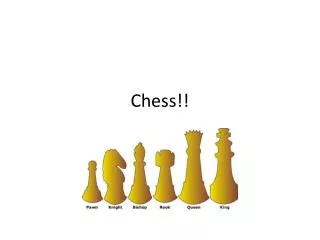
The game of Chess – pieces • Pawn: may only move forward (or capture diagonally) • Bishop: diagonals • Knight: L shaped moves. The only “unblockable” piece • Rook: Ranks & files • Queen: Bishop & Rook combined • King: 1 square in any direction. May not move into attacked square Values : 1 3 3/3.5 5 9 ∞
The game of Chess – example • White has over 30 possible moves • If black’s turn – can capture pawn at c3 and check (also fork)
The game of Chess – Check and Checkmate • “Checking” is attacking opponent’s king. Opponent must respond • “Mating” (Checkmate) is when the opponent can’t avoid losing the king – and thus forfeiting the game
Human & Artificial Players – AI search • AI uses search to assign a score to a board • Traverse the move tree from leaves - up • Select the best child using scores found • Only partial tree Computer is O (Max) opponent is X
Human & Artificial Players – The Machine • Millions of boards (nodes) per second • Little time for each board – less knowledge • Smart search algorithms – • pruning • Alpha-beta variants (negascout etc.) • Still use heuristics at end – can’t see all tree • Most research revolves around search • Human resemblance minimal – humans use little search
Human & Artificial Players – Humans • Humans use problem solving cognition • Deeply knowledge based – • Extensive “theory” exists • Numerous books and institutions • Massive use of pattern recognition • Also use search but • Less deep • Only develop “good” positions • More efficient – less nodes for “same” result • Reminiscent of greedy search • Not only in chess
Human & Artificial Players – Grand Masters - Findings • Play against several opponents at the same level they play against a single opponent • GMs and novices: same level of performance when memorizing a random board; differ when memorizing real game positions • GM eye movements show they only scan “correct” parts of board • Strong Amateurs use the same meta-search as GMs - equally deep, same nodes, same speed; Differ in knowledge of domain (De Groot)
Endgames - example • White’s turn: mate in 5, with Qe6+ • Features include: • #moves for black king minimal • Attacking, un-attacked • Checking • Officers same line\row • Black’s turn: draw with: Rc1+, then Qg5 – fork & exchange
Endgames (2) - features • Few pieces remain (typically: king, 0-3 officers and sometimes pawns) • Fewer options, but more moves for each piece • Trees still extremely large
Endgames - Building Blocks • Main goals • Reduce search by “smart” features of the board • Use more game knowledge as humans do • Allow more complex features to be built by supplying basic ones (terminals) and building methods (functions) • Schemata evolution
Features Example - Fork • My piece is: • Attacking 2 or more pieces • Protected or not attacked • Opponent pieces: • Unprotected • OR protected but of greater value • Example: black must exchange Q for R because of fork
Fork: Traditional AI search • Only 3 legal moves for black • Find that one of white’s next moves (out of 23 possible) captures black queen • Check all following moves for more piece exchanges • Sometimes, still check other moves (non capturing) • At end of search – compare remaining pieces • No fork “concept”
Features Example – Fork Feature Search (GP) • One of the features is isMyFork function – Checks all previously defined conditions • Also, use some smaller building blocks: • Is Opponent piece Attacked? • Is attacking piece protected? • Is opponent in check? • Value of attacked piece
GP Problem Definition • Terminals & Functions • Numerous “chess terminals” and ERCs • Non-chess funtions • Fitness • Tournament • Run parameters • Termination • We will see each element in the following experiments
Endgame experiments conducted • KRKR – each player has 1 king and 1 rook • KRRKR – King with 2 Rook against King and Rook • KRRKRR • KQKQ – Kings and Queens • KQRKQR – Combined
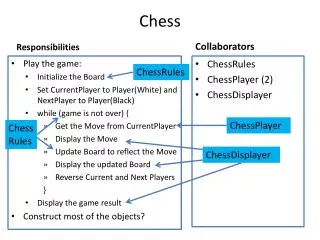
Basic program architecture • Generate all possible moves (depth=1) • Evaluate each board with GP individual • Select board with best score (or stochastically decide between equal) • Perform best move • Repeat process with GP opponent until game ends (or until only kings left)
KRKR Endgame • Each player has 1 King, 1 Rook • “Toy” problem for chess endgames • Theoretical draw (experts never lose this) • Some interesting positions exist
KRKR Endgame - what needs to be learned (1) • Avoid losing rook • Don’t move to attacked, unprotected squares • Vice versa - capture opponent’s rook if able Black to move – white loses Rook
KRKR Endgame - what need to be learned (2) • Avoid getting king stuck in edges • Again, take advantage if opponent does this Black to move – mate in 1
KRKR Endgames - Terminals • Used in first runs: • Is My Rook Attacked, Is Opp Rook attacked • Is {My, Opp} Rook Protected (two as above) • Is {My, Opp} Rook In Play • Num Moves {My, Opp} king • {My, Opp}-King’s proximity to edges • Is Mate • ERCs: ± {0.25, 0.5, 1} * MAX • MAX = 1000 (empirically)
KRKR Endgames - Functions • Boolean • OR2, OR3, OR4 • AND2, AND3, AND4 • NOT • Arithmetic - +, -, * • Combined - <, =, >, IF • STGP • For now, no “chess” functions, only terminals
KRKR Endgames - Fitness • Competitive, Random-2-ways • Each individual plays against k randomly selected opponents • Each game counts for both players • For each encounter • Several games (typically 4) are played • Short games - ~5-8 moves per player • Each game starts at a random legal position • Safe start - no piece is attacked at the beginning
KRKR Endgames – Fitness(2) • Scoring method: • Victory: 1-2 points • Piece count advantage (theoretical win) – ¾ point • Draw: ½ point • After advantage – 0 points • Loss: 0 points
KRKR Endgames – Parameters • Population size - 80 • #Generations - 150..250 • Operators: • Reproduction 0.35 • Crossover 0.5 • Mutation 0.15 (including ERC mutation) • Termination – ~10-25 hours
KRKR Endgames – Results • Every 10 generations, best individual played against: • Best of generation 0 • An opponent performing random moves • Longer games: ~10-12 moves per player • 50-150 games • Games were doubled – each player staring from both positions
KRKR Endgames – Results • Bad results – no distinct improvement • Several reasons: • Arithmetic operations problematic – we get large numbers • Mate not distinct enough (traditionally terminates the search) • Boolean functions not clear enough • Slow Runs due to large trees with repeating functions
KRKR Endgames –Improvements • Boolean functions • Divided to good and bad • Example: Is-My-King-In-Check changed to Is-My-King-Not-In-Check • Mate changed to 1000*Mate • Added Not-My-Rook-Attacked-Unprotected and Opp-Rook-Attacked-Unprotected
KRKR Endgames – Results - Improvements • Also consulted Chess Experts – added more: • Is-Opp-King-Behind-Rook • Split to • Opp-King-Prox-Rook • Opp-King-Behind-Rook • Is-Stalemate (only kings left) Black moves and White loses Rook
KRKR Endgames – Results - Improvements • Arithmetic functions canceled • Although Still using floats for terminals • Also divide to good and bad: NumNotMovesOppKing • Theoretically justified – more “logical” search in literature • Empirically - need more logical rules, and not : ( > (+ (#moves-k #moves-opp-k) 5.5)) • Memoization – saves more than ½ the time
KRKR Endgames – Final Results • Improvement • Above 75% of games against random end in advantage or mate • Still, too few mates, even when score for win is increased – difficult to learn move sequence • Same against best of generation 0 (almost random) • The main thing that was learned was avoiding getting the rook captured
KRRKR Endgames • Example (right) • Very good for white • Black king exposed • 2 rooks close • Next move – captures rook • (mate in 5)
KRRKR Endgames - goals • One player has 2 rooks, the other – 1 • Not theoretically drawn • We want one generalized individual for all endgames and positions (Not one for each endgame): • Each player needs to play both advantage, draw (KRKR) and disadvantage • Terminals need to be more general
KRRKR Endgames - changes • Terminals - changed and added to cope with changing state • Material-Count (recall each rook = 5) • Num-My-Pieces-Not-Attacked, since now there are more than 1 • Is-My-King-Protecting-Piece and My-Officers-Same-Line to allow more complex considerations • Functions • If-Adv-Then-(left child)-Else-(right child) • Eventually divided to 3 trees
KRRKR Endgames - changes • Also added – comparing differences to parent node • Boolean Is-Material-Increase, which compares to the parent node (board) • Material decrease is not needed since considering only my move • Not-My-King-Moves-Decreaseto further use number of moves for king
KRRKR Endgames – Opponents • Random forsaken; Best-of-0 still used but less • Added new opponent – MASTER • a program we wrote based on consultation with experts, highest being InternationalMaster Boris Gutkin, ELO 2400 (only about 3000 of those…) • Used ~50 general positions and rules derived from them, together with scores for each • Defined a strategy (“Expert”) accordingly • Tested evolved programs against it • Human competitive?
KRRKR Endgames – Fitness • Test were conducted by assigning each player both roles for each position • Fitness was refined – score effected by: • Starting position (advantage or disadvantage) • End result – win, loss or draw • Adv position ending in draw receives a score of near zero • Dis-adv ending in a draw will receive better than 0.5
KRRKR Endgames – Results • Expert-defined performed extremely well against Random and Best0 • Evolved programs performed generally as well as expert defined, sometimes better Percent of favorable results in game outcomes
Main Experiment – KQRKQR • Most complex endgame we worked with • Still theoretical draw • Highly position dependant – “noisy” • Larger trees • 2 officers • Queens • Easier to mate
KQRKQR Endgames - changes • Added – more “heavy” terminals (and components) • Boolean Is-Not-Mate-in-one, most time consuming but necessary • Boolean Is-My-King-Not-Trapped • Not all king’s moves lead closer to edges • Important but vague – usually happens with complex terminals • My-Officers-Same-Line
KQRKQR Endgames – New Opponent • CRAFTY, second in the 2004 Computer Chess Championship (held at Bar-Ilan) • Uses brute force methods; State-of-the-art search algorithms • Specializes in Blitz games (typically 3 minutes per game) • We limited to 5 secs per move, enough to scan ~1.5 Million boards with pruning
KQRKQR Endgames – Our parameters • Used lookahead of depth 2 • Typically ~5 secs per move • Simple Minimax search, but not Alpha-Beta • Played 5-6 moves per game • Never cancelled a game, even if it started with mate-in-4 (which CRAFTY easily saw) • Played each position 2 times, switching places • ~100 games - reduce noises in starting positions