Elevation Angle and Phase Residuals Analysis from Single Satellite Observations
This study investigates the phase residuals and elevation angle impacts based on single satellite observations in various heights (0.15 m, 0.6 m, and 1 m). It considers multipath contributions and analyzes simple geometry for both direct and reflected signals. Key findings include correlations between height estimates and zenith delay as a function of minimum elevation angles. The results feature data from PBO station in Washington and BARD station in California, allowing comprehensive insights into the effects of microwave absorbers and height variations on phase measurements.

Elevation Angle and Phase Residuals Analysis from Single Satellite Observations
E N D
Presentation Transcript
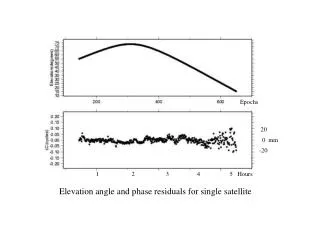
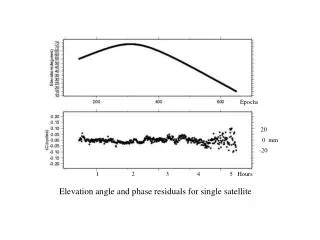
Epochs 20 0 mm -20 1 2 3 4 5 Hours Elevation angle and phase residuals for single satellite
Simple geometry for incidence of a direct and reflected signal Multipath contributions to observed phase for an antenna at heights (a) 0.15 m, (b) 0.6 m, and (c ) 1 m. [From Elosegui et al, 1995]
Top: PBO station near Lind, Washington. Bottom: BARD station CMBB at Columbia College, California
Left: Phase residuals versus elevation for Westford pillar, without (top) and with (bottom) microwave absorber. Right: Change in height estimate as a function of minimum elevation angle of observations; solid line is with the unmodified pillar, dashed with microwave absorber added [From Elosequi et al.,1995]
Correlation between estimates of height and zenith delay as function of minimum elevation angle observed (VLBI, from Davis [1986])
Uncertainty in estimated height as function of minimum elevation angle observed (VLBI, from Davis [1986]; dotted line with no zenith delay estimated)
GPS adjustments to atmospheric zenith delay for 29 June, 2003; southern Vancouver Island (ALBH) and northern coastal California (ALEN). Estimates at 2-hr intervals.