Download
1 / 1
10 likes | 131 Views
Watching Nanoscale Octahedra Crystallize Joel D. Brock, Cornell University, DMR 0936384 .

E N D
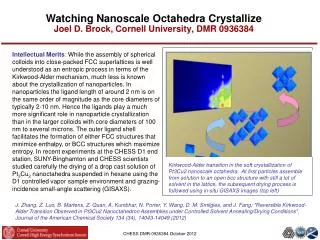
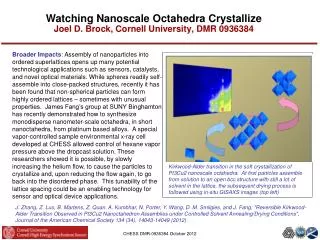
Watching NanoscaleOctahedraCrystallizeJoel D. Brock, Cornell University, DMR 0936384 Broader Impacts: Assembly of nanoparticles into ordered superlattices opens up many potential technological applications such as sensors, catalysts, and novel optical materials. While spheres readily self-assemble into close-packed structures, recently it has been found that non-spherical particles can form highly ordered lattices – sometimes with unusual properties. James Fang’s group at SUNY Binghamton has recently demonstrated how to synthesize monodisperse nanometer-scale octahedra, in short nanoctahedra, from platinum based alloys. A special vapor-controlled sample environmental x-ray cell developed at CHESS allowed control of hexane vapor pressure above the dropcast solution. These researchers showed it is possible, by slowly increasing the helium flow, to cause the particles to crystallize and, upon reducing the flow again, to go back into the disordered phase. This tunability of the lattice spacing could be an enabling technology for sensor and optical device applications. Kirkwood-Alder transition in the soft crystallization of Pt3Cu2 nanoscaleoctahedra. At first particles assemble from solution to an open bcc structure with still a lot of solvent in the lattice, the subsequent drying process is followed using in-situ GISAXS images (top left) J. Zhang, Z. Luo, B. Martens, Z. Quan, A. Kumbhar, N. Porter, Y. Wang, D. M. Smilgies, and J. Fang; "Reversible Kirkwood-Alder Transition Observed in Pt3Cu2 Nanoctahedron Assemblies under Controlled Solvent Annealing/Drying Conditions", Journal of the American Chemical Society 134 (34), 14043-14049 (2012) CHESS DMR-0936384 October 2012