Monroe's Era: Nationalism, Sectionalism, and Economic Challenges
150 likes | 258 Views
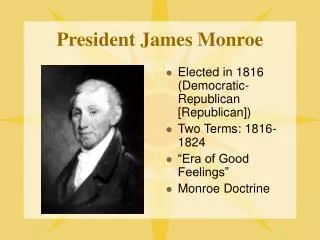
James Monroe's presidency, known as "The Era of Good Feelings," was marked by nationalism, the collapse of the Federalist Party, and economic challenges such as the Panic of 1819. His administration saw the reinforcement of federal power by the Marshall Court, the Missouri Compromise, Henry Clay's American System, and important foreign affairs events like the Monroe Doctrine. Explore this pivotal period in American history marked by political shifts, economic instability, and diplomatic initiatives that shaped the nation's future.


Monroe's Era: Nationalism, Sectionalism, and Economic Challenges
E N D
Presentation Transcript
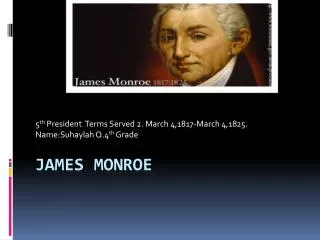
James Monroe 1817-1825 “The Era of Good Feelings”
Era of Good Feelings • Benjamin Russell • Feds die = 1 party rule • Nationalism • J.M. wins all but one electoral vote in 1820 • But D.R. Party split by sectionalism • Tariffs, nat. bank, internal improvements, sale of public lands
Panic of 1819 • Wild speculation on western lands • Overextended investments in manufacturing • Collapse of foreign markets • Commodity inflation • Contraction of credit – resumption of specie payments • Mismanagement of 2nd National Bank • State bank failures – in South & West
Resentment against the Bank • Thomas Hart Benson of Missouri labels it “The Monster”
Marshall Court • Reinforces federal power: • Gibbons v Ogden • McCulloch v Maryland • Dartmouth v Woodward
Missouri Compromise • Rapid growth of West • Senate even at 11-11 • Missouri (slave) • Maine (free) • 36-30 • Preserves “Era of G. F.” but causes sectionalism
American System • Henry Clay • Internal Improvements (Vetoes Intra Improvements) • National Economy binding regional interests • Cumberland Road (National Road) • Erie Canal
Foreign Affairs • Canada: • Rush-Bagot Treaty • US/GB on Great Lakes • Treaty of 1818 • Fishing, Oregon, 49th Parallel
Foreign Affairs • Florida • 1817 Jackson pursues raiders • 1818 Destroyed Seminole, hung 2 Brits, pushed out Spanish Gov’t • Congress outraged (JQ Adams supports) • 1819 Spain “sells” for 5 million, US gave up claims on Texas
Monroe Doctrine • A foreign policy • Why issued? – Countries in Europe (Spain & Russia) were trying to expand to W. Hemisphere • Basic Ideas: “Europe Stay Out”
Monroe Doctrine • W. Hemisphere closed to further colonization • U.S. would not interfere with Europe’s internal affairs • U.S, would not interfere with any existing European colony