Download
1 / 18
180 likes | 285 Views
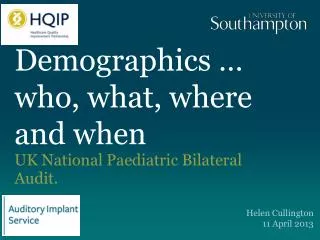
The UK National Paediatric Bilateral Audit offers vital insights into the performance of children with bilateral cochlear implants (CIs). This longitudinal study, conducted by Helen Cullington, highlights the strengths and weaknesses observed. With a total of 1,001 participants (465 in the simultaneous group and 536 in the sequential group), the research reveals significant data gaps, as many children were either excluded or had limited performance measures. Despite these challenges, the audit provides an invaluable perspective on the abilities of children with bilateral CIs and exemplifies successful collaborative efforts across the UK.

E N D
Demographics … who, what, where and when UK National Paediatric Bilateral Audit. Helen Cullington11 April 2013
Sequential Simultaneous
Simultaneousn=465 Professional rating scale Parental questionnaire Performance measure N/A N/A N/A N/A
Sequential n=536 Professional rating scale Parental questionnaire Performance measure N/A N/A N/A
Weaknesses • So much missing data • Children ‘dropped out’ and ‘dropped in’ • Performance testing limited on simultaneous group due to young age • Performance testing skewed by results only being obtained if child could do the test • 3 year interval only introduced in final year, so limited data • Longitudinal study in children – children get older each year!
Strengths • This is the population not a sample! • Unique and real picture of what children with bilateral CI can do • Cases not biased • Great example of collaborative work throughout UK
Caption for the image should be placed in a clear area on the image to ensure it is legible