Download
1 / 44
440 likes | 565 Views
Arrays are fundamental data structures used to store multiple items of the same type, enhancing data organization and access in programming. This guide explores the key concepts of arrays, including their definition, declaration, and memory allocation. It details how to read, access, and manipulate array elements, using practical examples such as printing numbers in reverse and initializing arrays with values. The importance of array indexing and how to pass arrays to functions is also highlighted, reinforcing essential programming skills.

E N D
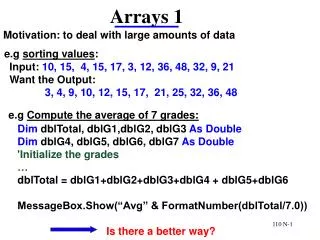
Array • Many applications require multiple data items that have common characteristics • In mathematics, we often express such groups of data items in indexed form: • x1, x2, x3, …, xn • Array is a data structure which can represent a collection of data items which have the same data type (float/int/char/…)
Example: Printing Numbers in Reverse 4 numbers 3 numbers int a, b, c, d; scanf(“%d”, &a); scanf(“%d”, &b); scanf(“%d”, &c); scanf(“%d”, &d); printf(“%d ”, d); printf(“%d ”, c); printf(“%d ”, b); printf(“%d \n”, a); int a, b, c; scanf(“%d”, &a); scanf(“%d”, &b); scanf(“%d”, &c); printf(“%d ”, c); printf(“%d ”, b); printf(“%d \n”, a);
The Problem • Suppose we have 10 numbers to handle • Or 20 • Or 100 • Where do we store the numbers ? Use 100 variables ?? • How to tackle this problem? • Solution: • Use arrays
Printing in Reverse Using Arrays void main() { int n, A[100], i; printf(“How many numbers to read? “); scanf(“%d”, &n); for (i = 0; i < n; ++i) scanf(“%d”, &A[i]); for (i = n -1; i >= 0; --i) printf(“%d ”, A[i]); printf(“\n”); }
x[0] x[1] x[2] x[9] X is a 10-element one dimensional array Using Arrays • All the data items constituting the group share the same name int x[10]; • Individual elements are accessed by specifying the index
Declaring Arrays • Like variables, the arrays used in a program must be declared before they are used • General syntax: type array-name [size]; • type specifies the type of element that will be contained in the array (int, float, char, etc.) • size is an integer constant which indicates the maximum number of elements that can be stored inside the array • marks is an array that can store a maximum of 5 integers int marks[5];
Examples: int x[10]; char line[80]; float points[150]; char name[35]; • If we are not sure of the exact size of the array, we can define an array of a large size int marks[50]; though in a particular run we may only be using, say, 10 elements
Accessing Array Elements • A particular element of the array can be accessed by specifying two things: • Name of the array • Index (relative position) of the element in the array • In C, the index of an array starts from zero • Example: • An array is defined as int x[10]; • The first element of the array x can be accessed as x[0], fourth element as x[3], tenth element as x[9], etc.
Contd. • The array index must evaluate to an integer between 0 and n-1 where n is the maximum number of elements possible in the array a[x+2] = 25; b[3*x-y] = a[10-x] + 5; • Remember that each array element is a variable in itself, and can be used anywhere a variable can be used (in expressions, assignments, conditions,…)
A first example “data refers to a block of 10 integer variables, data[0], data[1], …, data[9] void main() { int i; int data[10]; for (i=0; i<10; i++) data[i]= i; i=0; while (i<10) { printf("Data[%d] = %d\n", i, data[i]); i++; } }
The result Array size should be a constant void main() { int i; int data[10]; for (i=0; i<10; i++) data[i]= i; i=0; while (i<10) { printf("Data[%d] = %d\n", i, data[i]); i++; } } Output Data[0] = 0 Data[1] = 1 Data[2] = 2 Data[3] = 3 Data[4] = 4 Data[5] = 5 Data[6] = 6 Data[7] = 7 Data[8] = 8 Data[9] = 9
How is an array stored in memory? • Starting from a given memory location, the successive array elements are allocated space in consecutive memory locations • x: starting address of the array in memory • k: number of bytes allocated per array element • a[i] is allocated memory location at address x + i*k Array a
Storage Output &Data[0] = 3221224480 &Data[1] = 3221224484 &Data[2] = 3221224488 &Data[3] = 3221224492 &Data[4] = 3221224496 &Data[5] = 3221224500 &Data[6] = 3221224504 &Data[7] = 3221224508 &Data[8] = 3221224512 &Data[9] = 3221224516 void main() { int i; int data[10]; for(i=0; i<10; i++) printf("&Data[%d] = %u\n", i, &data[i]); }
Initialization of Arrays • General form: type array_name[size] = { list of values }; • Examples: int marks[5] = {72, 83, 65, 80, 76}; char name[4] = {‘A’, ‘m’, ‘i’, ‘t’}; • The size may be omitted. In such cases the compiler automatically allocates enough space for all initialized elements int flag[ ] = {1, 1, 1, 0}; char name[ ] = {‘A’, ‘m’, ‘i’, ‘t’};
How to read the elements of an array? • By reading them one element at a time for (j=0; j<25; j++) scanf (“%f”, &a[j]); • The ampersand (&) is necessary • The elements can be entered all in one line or in different lines
Passing Arrays to Function • Array element can be passed to functions as ordinary arguments • IsFactor (x[i], x[0]) • sin (x[5])
Passing Entire Array to a Function • An array name can be used as an argument to a function • Permits the entire array to be passed to the function • The way it is passed differs from that for ordinary variables • Rules: • The array name must appear by itself as argument, without brackets or subscripts • The corresponding formal argument is written in the same manner • Declared by writing the array name with a pair of empty brackets
Whole Array as Parameters Only Array Name/address passed. [ ] mentioned to indicate that is an array. const int ASIZE = 5; float average (int B[ ]) { int i, total=0; for (i=0; i<ASIZE; i++) total = total + B[i]; return ((float) total / (float) ASIZE); } void main ( ) { int x[ASIZE] ; float x_avg; x [] = {10, 20, 30, 40, 50}; x_avg = average (x) ; } Called only with actual array name
Contd. void main() { int n; float list[100], avg; : avg = average (n, list); : } float average (int a, float x[]) { : sum = sum + x[i]; } We don’t need to write the array size. It works with arrays of any size.
Arrays used as Output Parameters void VectorSum (int a[ ], int b[ ], int vsum[ ], int length) { int i; for (i=0; i<length; i=i+1) vsum[i] = a[i] + b[i] ; } void PrintVector (int a[ ], int length) { int i; for (i=0; i<length; i++) printf (“%d “, a[i]); } void main () { int x[3] = {1,2,3}, y[3] = {4,5,6}, z[3]; VectorSum (x, y, z, 3) ; PrintVector (z, 3) ; } vector-sum.c
Reading into an array void main() { const int MAX_SIZE = 100; int i, size; float marks[MAX_SIZE]; float total=0; scanf("%d",&size); for (i=0; i<size; i++) { scanf("%f",&marks[i]); total = total + marks[i]; } printf("Total = %f \n Avg = %f\n", total, total/size); } Output 4 2.5 3.5 4.5 5 Total = 15.500000 Avg = 3.875000
A Warning • In C, while accessing array elements, array bounds are not checked • Example: int marks[5]; : : marks[8] = 75; • The above assignment would not necessarily cause an error • Rather, it may result in unpredictable program results
How to copy the elements of one array to another? • By copying individual elements for (j=0; j<25; j++) a[j] = b[j]; • The element assignments will follow the rules of assignment expressions • Destination array must have sufficient size
Example 1: Find the minimum of a set of 10 numbers void main() { int a[10], i, min; for (i=0; i<10; i++) scanf (“%d”, &a[i]); min = a[0]; for (i=1; i<10; i++) { if (a[i] < min) min = a[i]; } printf (“\n Minimum is %d”, min); }
Example 2:Computing cgpa const int nsub = 6; void main() { int grade_pt[nsub], cred[nsub], i, gp_sum=0, cred_sum=0; double gpa; for (i=0; i<nsub; i++) scanf (“%d %d”, &grade_pt[i], &cred[i]); for (i=0; i<nsub; i++) { gp_sum += grade_pt[i] * cred[i]; cred_sum += cred[i]; } gpa = ((float) gp_sum) / cred_sum; printf (“\n Grade point average: is %.2lf”, gpa); } Handling two arrays at the same time
Things you cannot do • You cannot • use = to assign one array variable to another a = b; /* a and b are arrays */ • use == to directly compare array variables if (a = = b) ……….. • directly scanf or printf arrays printf (“……”, a);
x=a++ - ++a; Right to left evaluation of the expression. First update (rightmost) a to 11. Leftmost a =>11 x=0 a=12
SUM = 12 + 22 + 32 + …+ N2 void main() { int N, count, sum; scanf (“%d”, &N) ; sum = 0; count = 1; while (count <= N) { sum = sum + count count; count = count + 1; } printf (“Sum = %d\n”, sum) ; return 0; }
Maximum of positive Numbers void main() { double max = 0.0, next; printf (“Enter positive numbers, end with 0 or a negative number\n”); scanf(“%lf”, &next); while (next > 0) { if (next > max) max = next; scanf(“%lf”, &next); } printf (“The maximum number is %lf\n”, max) ; }
Find the sum of digits of a number digit-sum.c
Find the sum of digits of a number void main() { int n, sum=0; scanf (“%d”, &n); while (n != 0) { sum = sum + (n % 10); n = n / 10; } printf (“The sum of digits of the number is %d \n”, sum); } digit-sum.c
Test if a number is prime or not void main() { int n, i=2; scanf (“%d”, &n); while (i < n) { if (n % i == 0) { printf (“%d is not a prime \n”, n); break; } ++i; } if (i == n) printf (“%d is a prime \n”, n); }
More efficient?? void main() { int n, i = 2, flag = 0; double limit; scanf (“%d”, &n); limit = sqrt(n); while (i <= limit) { if (n % i == 0) { printf (“%d is not a prime \n”, n); flag = 1; break; } i = i + 1; } if (flag == 0) printf (“%d is a prime \n”, n); }
Some Loop Pitfalls while (sum <= NUM) ; sum = sum+2; for (i=0; i<=NUM; ++i); sum = sum+i; for (i=1; i!=10; i=i+2) sum = sum+i; double x; for (x=0.0; x<2.0; x=x+0.2) printf(“%f\n”, x);
Some observations on for • Initialization, loop-continuation test, and update can contain arithmetic expressions for ( k = x; k <= 4 * x * y; k += y / x ) • Update may be negative (decrement) for (digit = 9; digit >= 0; --digit) • If loop continuation test is initially 0 (false) • Body of for structure not performed • No statement executed • Program proceeds with statement after for structure
Example • We can give several expressions separated by commas in place of expr1 and expr3 in a for loop to do multiple assignments for example for (fact=1, i=1; i<=10;++ i) fact = fact * i; for (sum=0, i=1; i<=N; ++i) sum = sum + i * i;