Download
1 / 11
110 likes | 213 Views
Learn how to model multiplication using base ten blocks for better understanding. Practice with examples of repeated addition and rectangular array models.

E N D
Ex. # 1 24 × 3 Instead of modeling 24 × 3, let’s model 3 x 24. You may use the commutative property of multiplication when modeling multiplication with base ten blocks.
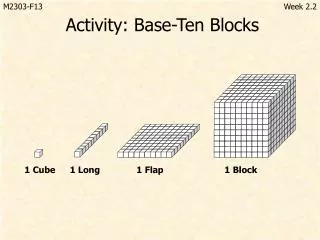
Ex. # 1 Repeated Addition Model (cont.)3 × 24 3 × 24 means 3 24’s. 24 is 2 longs and 4 units.
Ex. # 1 Repeated Addition Model (cont.)3 × 24 Join together. I now have 6 longs and 12 units.
Ex. # 1 Repeated Addition Model (cont.)3 × 24 Exchange 10 units for 1 long. I now have 7 longs and 2 units. 3 × 24 = 72, so 24 × 3 = 72.
Ex. # 2 Rectangular Array Model3 × 24 3 × 24 means 3 24’s. 24 is 2 longs and 4 units. Place 2 longs and 4 units in a rectangular array 3 times.
Ex. # 2 Rectangular Array Model (cont.)3 × 24 Count the number of blocks used. There are 6 longs and 12 units. Exchange 10 units for 1 long. There are 7 longs and 2 units. 3 × 24 = 72
Ex. # 3 Rectangular Array Model13 × 12 • Use 1 long and 3 units to outline a rectangle whose width is 13. • Use 1 long and 2 units to complete the outline of a rectangle whose length is 12. • Fill in the rectangle, using as few base ten blocks as possible.
Ex. # 3 Rectangular Array Model (cont.)13 × 12 Count the number of blocks used. There are 1 flat, 5 longs, and 6 units, so the product is 100 + 50 + 6 or 156. 13 × 12 = 156
Ex. # 4 Rectangular Array Model13 × 22 • Use 1 long and 3 units to outline a rectangle whose width is 13. • Use 2 longs and 2 units to complete the outline of a rectangle whose length is 22. • Fill in the rectangle, using as few base ten blocks as possible.
Ex. # 4 Rectangular Array Model (cont.)13 × 22 Count the number of blocks used. There are 2 flats, 8 longs, and 6 units, so the product is 200 + 80 + 6 or 286. 13 × 22 = 286