Understanding Market Structures: Perfect Competition, Monopoly, and Oligopoly Dynamics
Explore the four primary market structures: Perfect Competition, Monopoly, Monopolistic Competition, and Oligopoly. Perfect Competition features many sellers with identical goods, ensuring no single seller can influence market prices. In contrast, Monopoly involves a single seller dominating the market, creating barriers to entry and higher prices. Monopolistic Competition allows differentiation among products, while Oligopoly is characterized by a few sellers who are interdependent. Each structure has distinct characteristics, implications for pricing, and consumer choice.


Understanding Market Structures: Perfect Competition, Monopoly, and Oligopoly Dynamics
E N D
Presentation Transcript
Perfect Competition • Characteristics • Many sellers with identical goods and services – goods are perfect substitutes for each other (no particular seller has any large impact on the market) • No seller has price setting ability but rather MUST take the price the market sets • Easy to enter and exit a market • Perfect information – all firms know each others costs and the prices they charge • All firms have same access to resources • Consumers want to maximize satisfaction & Producers want to maximize profits
In PC market structure, firms DO NOT earn more than a normal profit (they do not cover opportunity costs – only out of pocket costs) • Excess profits act as a signal to other firms to enter the market thus lowering price as supply increases and wiping out extra profits Examples of PC Market • Agriculture • Stock Market
Monopoly • Mono means “ONE” so a monopoly is a market with only 1 seller of a good or service • Characteristics: • Lack of competition amongst sellers and lack of substitutes for the good/service • Barriers to entry: high cost of entering the market • Firms are “price makers” – they control the supply and so can influence the price they charge – HOWEVER they CAN NOT charge any price they want – the Law of Demand STILL APPLIES • Better information than other firms or the consumers • Less efficient than a competitive market so have lower quantities available and higher prices
Natural Monopoly • This is a monopoly where it makes more sense – it is more efficient to have only 1 seller of a good or service • The cost of competition makes it too expensive and unprofitable to have more than 1 seller • Examples are utilities
Monopolistic Competition • A firm that is able to influence the market price of its product by altering the rate of production of the product • There are many producers and many consumers in a given market. • Products are similar but NOT identical (differentiated) • Sellers have SOME control over the price of the good they charge • Few barriers to exit or entry from the market
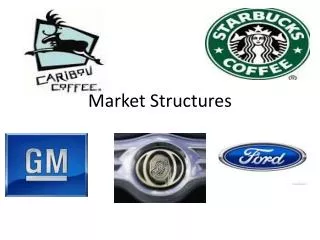
Oligopoly • An industry dominated by only a few sellers • Each seller is aware of the actions of the others and this influences how they act (called interdependence) • Oligopoly markets can include collusion – the act of collaborating or cooperating with your competitors to set production limits and influence prices • Sellers typically use non-price competitive methods to make their product stand out
Oligopoly Examples • Auto industry • Soda industry • Airline industry