Download
1 / 4
80 likes | 316 Views
This guide explores the classification of variables in statistics, including discrete and continuous numerical variables. Discrete variables result from counting processes, while continuous variables stem from measurement processes. Additionally, we delve into categorical variables that produce responses belonging to specific groups or classes. We also explain measurement levels, focusing on nominal and ordinal scales. Nominal scales classify data into groups, whereas ordinal scales provide rank ordering of items. Understanding these concepts is essential for accurate data analysis and interpretation.

E N D
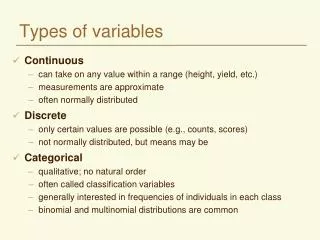
Classification of Variables Discrete Numerical Variable A variable that produces a response that comes from a counting process.
Classification of Variables Continuous Numerical Variable A variable that produces a response that is the outcome of a measurement process.
Classification of Variables Categorical Variables Variables that produce responses that belong to groups (sometimes called “classes”) or categories.
Measurement Levels Nominal and Ordinal Levels of Measurement refer to data obtained from categorical questions. • A nominal scale indicates assignments to groups or classes. • Ordinal data indicate rank ordering of items.