Download

1 / 23
230 likes | 392 Views
In "Cities Without Suburbs," David Rusk explores the dynamics of urban and suburban growth, emphasizing the importance of elasticity in cities. Elastic cities thrive by capturing suburban growth, while inelastic cities face economic decline and heightened segregation. The text categorizes metro areas based on their elasticity and discusses the characteristics that lead to urban deterioration. Rusk proposes strategies for revitalizing these cities, including government consolidation and promoting economic progress, advocating for necessary collaboration at all government levels to foster inclusivity and sustainable development.

E N D
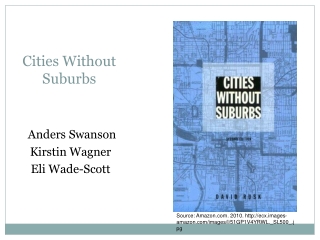
Cities Without SuburbsBy David Rusk Presented by Carissa Bunning Becky Canovan Lyndsay Leggott
Key Terms • Elastic • Inelastic • Metropolitan government
Introduction • Elastic vs. inelastic • Characteristics • Strategies • Conclusions
Characteristics of Metro Areas • 5 categories of elasticity • Zero • Low • Medium • High • Hyper
For a city’s population to grow, the city must be “elastic.”
Elastic cities “capture” suburban growth; inelastic cities “contribute” to suburban growth.
Fragmented local government fosters segregation; unified local government promotes integration.
The smaller the income gap between city and suburb, the greater the economic progress for the whole metropolitan community.
Poverty is more concentrated in inelastic cities than in elastic cities.
Characteristics of Metro Areas • The point of no return • City/suburb economic disparities • The city is no longer a place in which to invest or create jobs. • No city past the point of return has ever closed the economic gap with its suburbs by as much as a single percentage point!
Characteristics of Metro Areas • Cities without suburbs • 2 standards • 23 cities • Social equity • Economic mobility • Availability of resources
Strategies for Stretching Cities • End fiscal imbalance • Diminish racial and economic segregation • Promote economic progress • Control urban sprawl
Urban “Triage” • Preventative medicine • Out-patient treatment • Major surgery • Life-support systems
State Government Initiatives • Unify local governments • Consolidate city and county • Combine counties into regional governments • Consolidation impact • Authorize annexation • Limit new municipalities • Promote regional partnerships
Federal Government Initiatives • Incentives for metropolitan reorganization • Slowing urban sprawl • Leveling the playing field • Ending public housing contracts
Citizen Initiatives • Voluntary civic action • Business organizations • Chambers of commerce
Conclusions and Recommendations • Metro governments are the best solution for governing metro areas, however metro governments are not always plausible. • In this case, racial and economic integration must occur. • To achieve this, cooperation on the part of local, state, and federal governments is essential.
Sources • http://www.engr.utexas.edu/che/students/photos/austin-1.cfm