Download
1 / 42
420 likes | 536 Views
This extensive study guide provides detailed tips and examples for tackling extended response questions in Chapter 2 of Honors Biology. Key concepts covered include the properties of atoms and molecules, the behavior of water and its unique properties like surface tension, the role of H-bonding, and the classification of acids and bases. Additionally, it addresses important topics such as covalent and ionic bonds, pH calculations, and the significance of trace elements. Use this guide to deepen your understanding and excel in your biology studies!

E N D
EXTENDED RESPONSE TIPS: • EXAMPLE: • Surface tension caused by the pulling in of H-bonds of the water molecules. This creates a “film” on the surface of the water. • This allows small insects to walk on the surface of water.
#1 Atom = 1 unit – smallest unit of an element Molecule = 2 or more atoms chemically bonded (can be same or different) Formula = abbreviation of a compound Compound = 2 or more different elements bonded together chemically • Symbol = abbreviation of an element • Element = 1 kind of substance that cannot be broken down by chemical means – listed on Periodic table
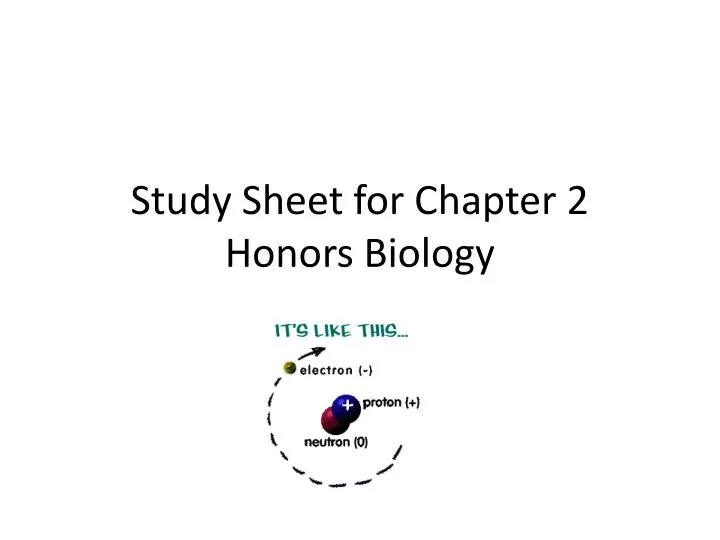
#2 • 59 • Co • 27 • Mass number = 59 • Atomic number = 27 • Number of protons = 27 • Number of electrons = 27 • Number of neutrons = 32
#3 • Trace elements • Appear in very small amounts • Milligrams (mg)
#4 • Radioactive isotope • Breaks down spontaneously • (gives off energy and particles, can be detected on a PET scan) • Break down to their more stable form • EX: C-14 to C-12
#5 • Why do atoms join to form compounds? • TO FILL THEIR OUTER ELECTRON SHELL
#6 • IONS and ISOTOPES • IONS = differ in the number of electrons (charged atoms) • ISOTOPES = differ in the number of neutrons (different mass numbers)
#7 • Electrons in covalent and ionic bonds • COVALENT = electrons are shared • IONIC = electrons are transferred (lost/gained)
#8 • Solute and solvent and solution Water = solvent – does the dissolving (larger amount) Sugar = solute –being dissolved Both = solution
#9 • H-bonding • When water reaches 4oC and below H-bonds form an open lattice (less dense) • For surface tension, H-bonds pull the water molecules inward to form a “film”
#10 • IN ORDER (strongest to weakest): • COVALENTIONICH-bonding Van der Waals
#11 • Buffers • Minimize the change in pH by adding extra H+ and OH-
#12 • ACIDS put H+ ions into solution • (H+ donors) • BASES put OH- ions into solution • (OH- donors)
#13 • Water has high heat of vaporization (slow to heat and also slow to cool) • So the coastal area temperatures would change less rapidly than inland areas
#14 ACIDS BASES Strong 11-14 Weak 8-10 pH 11 = 10-11 • Strong 1-3 • Weak 4-6 • pH 3 = [H+] 10-3 • pH 4 is 100 X’s the H+ ions than pH 6
#15 • Electrons fill • 2 • 8 • 8
#16 • ACID PRECIPITATION • pH lower than 5.2
#17 • COVALENT BONDS
#18 • H+ ions surround Cl- • OH- ions surround Na+
#19 • REACTANTS PRODUCTS • Left of arrow right of arrow
#20 • Elements that are located in the same column behave more alike chemically
#21 • Polar Covalent = unequal sharing of e- • Nonpolar Covalent = equal sharing of e-
#22 • Bohr Model
#23 H-H O-H NaCl
#24 • UNIQUE PROPERTIES OF WATER • 1. H-bonding • 2. Polarity
#25 • CHON • Trace element in mg
#25 • Fe • Used by RBC to carry oxygen in hemoglobin • I • used to prevent blindness and have proper use of thyroid • F • used to prevent tooth decay
#26 • Elements have different numbers of protons • Elements have different numbers of electrons (form different ions and different bonds)
#26 • Same column have same outer shell (valence) electrons
#27 • ISOTOPES OF AN ELEMENT • Same number of protons (same atomic number) • Different number of neutrons (different mass number)
#28 • Valence electrons (fill inner shell first) • 2 • 8 • 8
#29 • If atomic number 8 • Can form two more bonds
#30 • BOTH INTERMOLECULAR • Van der Waals = are momentary very weak forces of attraction between nonpolar molecules resulting from uneven electron distributions (EX: gecko hairs on feet and glass) • H-bonding = forces between H and F, O, or N
#31 • Cations = (+) ions • Anions = (-) ions
#32 You need to break the H-bonds to vaporize (form a gas)- takes extra time You need to form H-bonds to form ice – takes extra time
Determine the pH • [H+] [OH-] = 10-14 • If [H+] = 10-4 = pH 4 • [OH-] = 10-10
#34 • Mg-2 Cl- • K+ I- • Ca+2 P-3
#35 • REVIEW YOUR ELEMENTS AND SYMBOLS: • Ca = calcium • C = carbon • Co = cobalt
#36 EXAMPLE • Why water makes a nice drop on wax paper: • Surface tension on the water. • Strong cohesion of the water molecules • Weak adhesion to the wax paper. • Review blue sheet, water properties quiz and lab.