
Dynamic Storage Allocation Problem
E N D
Presentation Transcript
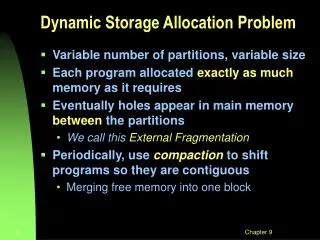
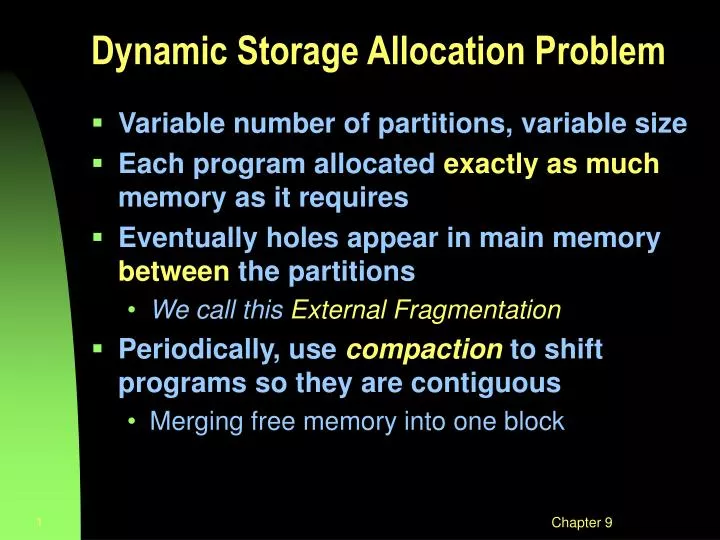
Dynamic Storage Allocation Problem • Variable number of partitions, variable size • Each program allocated exactly as much memory as it requires • Eventually holes appear in main memory between the partitions • We call this External Fragmentation • Periodically, use compaction to shift programs so they are contiguous • Merging free memory into one block Chapter 9
Dynamic Storage-Allocation • OS keeps a table indicating which parts of memory are available and which are occupied. • Initially all memory is available for user processes (set of holes contains 1 large hole) • When processes arrive and need memory, search for a hole big enough • If a hole is too large, split in 2 (1 part for process, 1 part returned to set of holes) • If new hole is adjacent to other holes, may be merged to form 1 larger hole Chapter 9
Dynamic Partitioning: an example • (a-d) P1, P2, P3 are allocated memory. • P4 needs 128k: but after loading first 3, there is only a single hole of 64k, so P4 must wait. • Eventually all 3 processes are blocked • OS swaps out P2 (closest fit) and brings in P4 (128k) Chapter 9
Dynamic Partitioning: an example • (e,f) remove process 2, load process 4 leaves a hole of 224-128=96K (external fragmentation) • (g,h) Process 1 suspended to bring in process 2 again, creating another hole of 320-224=96K... • Left with 3 small and probably useless holes. Compaction would produce a single hole of 96+96+64=256K Chapter 9
Placement Algorithm • Decide which free block to allocate to a program • Possible algorithms: • Best-fit: choose smallest hole that fits • creates small holes! • First-fit: choose first hole from beginning that fits • generally superior • Next-fit: variation: first hole from last placement that fits • Worst-fit: use largest hole • leaves largest leftover (also worst fit)
Advantages/Disadvantages of Placement Algorithms • First fit and best fit are generally better than worst fit • Both are better in terms of storage • First fit is faster than both best and worst fit • All suffer from external fragmentation • Exists enough total memory exists to satisfy a request, but it is not contiguous (lots of small holes) • Worst case can have small block of memory between every 2 processes Chapter 9
Compaction • External fragmentation can be resolved through compaction • Shuffles the memory contents to put all free memory together in one block • Compaction algorithm is expensive, but so is not making efficient use of memory, especially with a lot of concurrent processes • Only possible if relocation is dynamic • Relocation requires moving program and data, changing the base register Chapter 9
Relocation • Because of swapping and compaction, a process may occupy different main memory locations during its lifetime • So we usually use special hardware to perform address mapping to allow us to support relocation at run time • We will distinguish between logical address and physical address: Chapter 9
Address Terminology • Physical address: a physical location in main memory, from the point of view of the memory system. • Logical (virtual) address: an address as used in a program, an address as generated by the CPU when executing that program • so an address from point of view of the CPU Chapter 9
Memory Management Unit (MMU) memory relocation register (base reg) 14000 MMU CPU logical address physical address 123 14123 + • 32 bit address register = 4 Gigabytes of virtual memory • Actually only 64 (128..) Megabytes of physical memory • Need to map down from a large virtual address space to a smaller physical memory space Chapter 9
Paging • Fragmentation is a significant problem with all these memory management schemes • Let’s organize physical address spaced (main memory) into equal (small) sized chunks called frames. • And divide logical (virtual) address space into chunks of the same size called pages • The pages of a program can thus be mapped to the available frames in main memory, not necessarily contiguous • Result: a process can be scattered all over the physical memory. Chapter 9
..now suppose that process B is swapped out Example of Program Loading by Page Chapter 9
Process Loading by Page • Now process D consisting of 5 pages is loaded • Program D does not occupy a contiguous section of memory • No external fragmentation! • Internal fragmentation limited to part of the last page of each program (average 1/2 page/program). Chapter 9
Page Tables • We keep a page table for each process • A page table entry is the frame number where the • corresponding page is physically located • Page table is indexed by page number to obtain the • frame number • We also need a Free frame list to keep track of • unused frames
Logical Address in Paging • Within each program, each logical address consists of a page number and an offset within the page • A Memory Management Unit (MMU) is put between the CPU address bus and physical memory bus • A MMU register holds the starting physical address of the page table of the process currently running • Presented with a logical address (page number, offset) the MMU accesses the page table to obtain the physical address (frame number, offset) Chapter 9