From Strategy to Execution_ Supply Chain Mastery Program
Gain practical exposure to logistics and supply chain workflows through real-world learning methods. The course addresses everyday operational challenges faced by supply chain professionals. You will learn inventory and demand management techniques. Planning accuracy and execution speed are improved. Industry-relevant tools and frameworks are introduced. Operational efficiency across supply chain stages is enhanced. This program builds job-ready logistics management skills.

From Strategy to Execution_ Supply Chain Mastery Program
E N D
Presentation Transcript
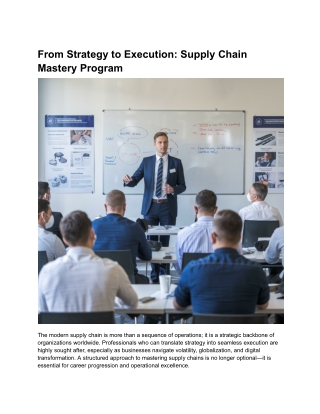
From Strategy to Execution: Supply Chain Mastery Program The modern supply chain is more than a sequence of operations; it is a strategic backbone of organizations worldwide. Professionals who can translate strategy into seamless execution are highly sought after, especially as businesses navigate volatility, globalization, and digital transformation. A structured approach to mastering supply chains is no longer optional—it is essential for career progression and operational excellence.
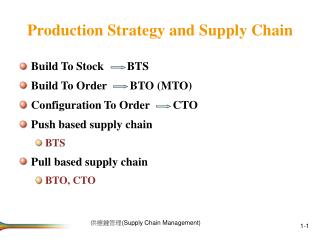
The Supply Chain Mastery Program emphasizes both strategic planning and practical execution, equipping professionals to make informed decisions that impact the entire value chain. Why Strategy Matters in Supply Chain Roles Organizations often struggle when their supply chain strategy is disconnected from execution. Strategy guides decisions on sourcing, production, inventory management, and distribution, ensuring resources are allocated efficiently. Professionals trained in Supply Chain Strategy learn to align operational activities with broader business goals, creating coherence across functions. Strategic thinking in supply chains enhances resilience, improves service levels, and supports sustainable growth. It also positions professionals as advisors who can influence organizational decision-making beyond day-to-day operations. Turning Strategic Insights into Operational Excellence A key challenge in supply chains is bridging the gap between strategy and execution. Knowledge of Operations Management allows professionals to implement strategies effectively, optimize workflows, and monitor performance. By understanding operational constraints, leaders can anticipate bottlenecks and design solutions that align with strategic objectives. This dual focus ensures that plans are realistic, measurable, and adaptable, ultimately reducing waste, improving delivery timelines, and enhancing customer satisfaction. Navigating Complexity with Advanced Planning Global supply chains involve multiple stakeholders, regions, and regulatory frameworks. Skills in Supply Chain Planning enable professionals to forecast demand accurately, optimize inventory levels, and coordinate production schedules across geographies. Advanced planning also involves scenario analysis to handle uncertainty. Professionals trained in these methods can simulate disruptions, identify risks, and design mitigation strategies before issues escalate. Leveraging Data for Informed Decisions Data is a critical asset in today’s supply chains, but its value depends on interpretation. Professionals trained in Supply Chain Analytics can convert complex datasets into actionable insights. From supplier performance metrics to transportation efficiency and customer demand trends, analytics informs strategic and operational decisions.
Data literacy empowers professionals to make evidence-based recommendations, reduce inefficiencies, and anticipate market changes more effectively than intuition alone. Building Resilient Supply Chains with Risk Management Global operations are exposed to natural, geopolitical, and technological risks. Knowledge of Supply Chain Risk Management helps professionals identify vulnerabilities, develop contingency plans, and maintain business continuity under stress. Risk-aware professionals are more confident in decision-making and can guide teams through crises, ensuring minimal operational impact while preserving stakeholder trust. Complementary Skills for Comprehensive Mastery Supply chain mastery does not exist in isolation. Many professionals enhance their profiles with Project Management Certification to lead initiatives efficiently, Lean Six Sigma Training to streamline processes, or Business Analytics Courses to enhance decision-making. Integrating these skills with supply chain knowledge creates versatile leaders capable of managing cross-functional challenges. Platforms like Unichrone offer structured programs that combine these areas, preparing professionals for end-to-end operational and strategic responsibilities. Real-World Perspectives from Industry Experts “Applying both strategic insights and operational techniques transformed how I manage our supply chain. Our team is more proactive, and decisions are now backed by data.” — Senior Supply Chain Manager, FMCG Sector “Learning advanced planning and risk management allowed me to reduce delays significantly and communicate more effectively with stakeholders. It changed how leadership perceives the operations team.” — Operations Lead, Manufacturing Industry Integrating Sustainability into Supply Chain Execution Sustainability is now a core consideration rather than a peripheral initiative. Knowledge of Sustainable Supply Chain Practices allows professionals to design environmentally responsible processes, optimize resource use, and comply with regulations. Leaders who integrate sustainability into daily operations support both corporate responsibility goals and efficiency gains, positioning their organizations for long-term success. Preparing for Leadership in Cross-Functional Environments
Professionals with mastery over both strategy and execution are well-positioned for leadership roles. Skills in End-to-End Supply Chain Management allow them to oversee multiple functions, balance cost and service, and drive initiatives that influence enterprise-wide outcomes. Exposure to complementary disciplines like Quality Management, Business Process Improvement, and Change Management equips professionals to manage complexity while maintaining operational excellence. Career Benefits of Supply Chain Mastery Developing mastery in supply chains accelerates career growth by creating professionals who can operate at strategic and operational levels. Such individuals are highly adaptable, capable of leading transformation initiatives, and trusted to influence long-term organizational decisions. This versatility supports role transitions into senior leadership, global operations management, or consulting opportunities where strategic insight and execution experience are equally valued. FAQs Who benefits most from a Supply Chain Mastery Program? Operations managers, supply chain analysts, procurement professionals, and mid-level managers preparing for strategic or leadership roles. Does supply chain mastery focus only on logistics? No. It covers planning, strategy, risk management, analytics, and operational execution across the entire supply chain. How does supply chain mastery improve organizational impact? It enables professionals to align strategy with execution, anticipate disruptions, optimize resources, and support sustainable growth. Can mastery programs be combined with other professional courses? Yes. They complement Project Management, Lean Six Sigma, Business Analytics, and Quality Management Training to create a well-rounded professional profile. Is mastery training useful for long-term career growth? Absolutely. Professionals gain versatility, strategic insight, and execution capabilities, positioning them for leadership and cross-functional roles.