
Risk Management
E N D
Presentation Transcript
Risk Management Chapter 3 3-1
Learning Objectives • Define risk. • Define risk management. • Discuss the meaning of and the process for risk identification. • Discuss the meaning of and the process for risk evaluation. • Discuss the meaning of and the process for risk control. Cont. 3-2
Learning Objectives • Discuss the use of a cause and effect diagram. • Explain the interrupting the accident sequence process. • Discuss the components and use of the Haddon Matrix. • Differentiate between passive and active, and voluntary and mandatory risk reduction strategies. • Apply risk control strategies to an injury problem. 3-3
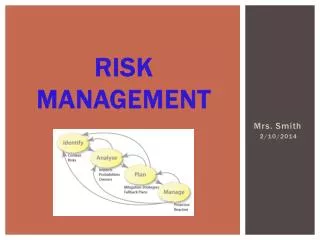
Introduction • Risk as defined by NFPA 1500 • Risk Management includes five components: • Risk identification • Risk evaluation • Establishment of priorities for action • Risk control • Risk management monitoring • Risk management is recommended in Life Safety Initiative 3 3-4
Risk Identification • Anything bad that could happen to an organization • Local experience • Identification of trends • Safety audit • Reviewing previous injury experience 3-5
Risk Evaluation • Frequency • How often a particular risk is likely to occur • Severity • Measurement of how great the loss or the consequences of the loss will be • Costs • Organizational impact • Establishment of Priorities for Action 3-6
Frequency and Severity Frequency and Severity of Identified Risks 3-7
Risk Control • Three broad categories • Risk avoidance • Not to do the task with which the risk is associated • Option not usually available to emergency response profession • Nature of the profession • Called when things have already gone wrong Cont. 3-8
Risk Control • Three broad categories (cont.) • Risk reduction • Reduce the risk or minimize the chance that it will occur • Measures must involve input from the employees who are affected • Cause and effect diagrams • Interrupting the Accident Sequence • The Haddon Matrix Cont. 3-9
Risk Control • Three broad categories (cont.) • Risk transfer • Closely related to the safety and health program • The amount paid for insurance based on previous experience, including injuries, accidents, and other risks • Workers’ Compensation Insurance • Management Liability • General Liability • Property Insurance • Vehicle Insurance 3-10
Interrupting the Accident Sequence Classification of Events Leading to Back Injury 3-11
Control Measures Completed Matrix Comparing Voluntary and Mandatory Passive and Active Measures 3-12
Summary • Risk management is a five-step process: • Risk identification • Risk evaluation • Establishment of priorities for action • Risk control • Risk management monitoring • Safety and health program management is not only subjective • Programs have objective components that are the foundation for local decision making 3-13