Markov Decision Processes and Reinforcement Learning
110 likes | 137 Views
Learn about MDPs, sequential decision problems, balancing risks and rewards, policies, utility, grid worlds, finite and infinite horizons, discounted rewards, value functions, and the Bellman Equation.


Markov Decision Processes and Reinforcement Learning
E N D
Presentation Transcript
Overview • MDPs • Reinforcement learning
Sequential decision problems • In an environment, find a sequence of actions in an uncertain environment that balance risks and rewards • Markov Decision Process (MDP): • In a fully observable environment we know initial state (S0) and state transitions T(Si, Ak, Sj) = probability of reaching Sj from Si when doing Ak • States have a reward associated with them R(Si) • We can define a policy π that selects an action to perform given a state, i.e., π(Si) • Applying a policy leads to a history of actions • Goal: find policy maximizing expected utility of history
4x3 Grid World • Assume R(s) = -0.04 except where marked • Here’s an optimal policy
4x3 Grid World Different default rewards produce different optimal policies life=pain, get out quick Life = struggle, go for +1, accept risk Life = good, avoid exits Life = ok, go for +1, minimize risk
Finite and infinite horizons • Finite Horizon • There’s a fixed time N when the game is over • U([s1…sn]) = U([s1…sn…sk]) • Find a policy that takes that into account • Infinite Horizon • Game goes on forever • The best policy for with a finite horizon can change over time: more complicated
Rewards • The utility of a sequence is usually additive • U([s0…s1]) = R(s0) + R(s1) + … R(sn) • But future rewards might be discounted by a factor γ • U([s0…s1]) = R(s0) + γ*R(s1) + γ2*R(s2)…+ γn*R(sn) • Using discounted rewards • Solves some technical difficulties with very long or infinite sequences and • Is psychologically realistic
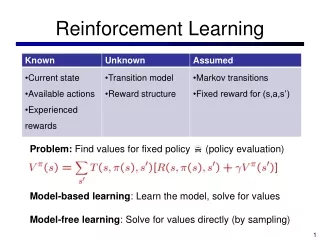
Value Functions • The value of a state is the expected return starting from that state; depends on the agent’s policy: • The value of taking an action in a stateunder policy p is the expected return starting from that state, taking that action, and thereafter following p :
Bellman Equation for a Policy p The basic idea: So: Or, without the expectation operator: