Understanding Electromagnetic Waves: The Interplay of Electric and Magnetic Fields
180 likes | 308 Views
This exploration of electromagnetic waves delves into the fundamental concepts of electric and magnetic fields, their perspectives, and transformations. It covers key principles like Ampère's law, the displacement current, and Maxwell's equations, which predict the existence of electromagnetic waves across all frequencies, illuminating our understanding of light. The text discusses the properties of electromagnetic waves, including their transverse nature, Poynting vector, and implications of radiation pressure. It also introduces Malus's Law, highlighting the behavior of light through polarizing filters.


Understanding Electromagnetic Waves: The Interplay of Electric and Magnetic Fields
E N D
Presentation Transcript
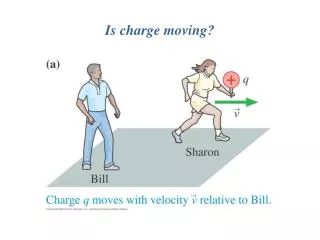
E or B? It Depends on Your Perspective Whether a field is seen as “electric” or “magnetic” depends on the motion of the reference frame relative to the sources of the field.
E or B? It Depends on Your Perspective The Galilean field transformation equations are where V is the velocity of frame S' relative to frame S and where the fields are measured at the same point in space by experimenters at rest in each reference frame. NOTE: These equations are only valid if V << c.
Ampère’s law Whenever total current Ithrough passes through an area bounded by a closed curve, the line integral of the magnetic field around the curve is The figure illustrates the geometry of Ampère’s law. In this case, Ithrough = I1− I2 .
The Displacement Current The electric flux due to a constant electric field E perpendicular to a surface area A is The displacement current is defined as Maxwell modified Ampère’s law to read
Electromagnetic Waves • Maxwell, using his equations of the electromagnetic field, was the first to understand that light is an oscillation of the electromagnetic field. Maxwell was able to predict that • Electromagnetic waves can exist at any frequency, not just at the frequencies of visible light. This prediction was the harbinger of radio waves. • All electromagnetic waves travel in a vacuum with the same speed, a speed that we now call the speed of light.
Properties of Electromagnetic Waves Any electromagnetic wave must satisfy four basic conditions: • The fields Eand B and are perpendicular to the direction of propagation vem.Thus an electromagnetic wave is a transverse wave. • Eand B are perpendicular to each other in a manner such that E× B is in the direction of vem. • The wave travels in vacuum at speed vem = c • E = cBat any point on the wave.
Properties of Electromagnetic Waves The energy flow of an electromagnetic wave is described by the Poynting vector defined as The magnitude of the Poynting vector is The intensity of an electromagnetic wave whose electric field amplitude is E0 is
Radiation Pressure It’s interesting to consider the force of an electromagnetic wave exerted on an object per unit area, which is called the radiation pressure prad.The radiation pressure on an object that absorbs all the light is where I is the intensity of the light wave. The subscript on prad is important in this context to distinguish the radiation pressure from the momentum p.
Malus’s Law Suppose a polarized light wave of intensity I0 approaches a polarizing filter. θ is the angle between the incident plane of polarization and the polarizer axis. The transmitted intensity is given by Malus’s Law: If the light incident on a polarizing filter is unpolarized, the transmitted intensity is In other words, a polarizing filter passes 50% of unpolarized light and blocks 50%.