Estimating Explosion Hazards in a Thermal Reaction Simulation for Cumene Hydroperoxide
270 likes | 398 Views
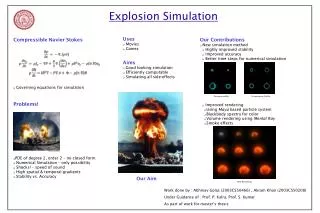
This tutorial exercise focuses on creating a simulation project to assess explosion hazards in a storage tank containing an 80% solution of cumene hydroperoxide. Using a well-stirred assumption, the exercise aims to determine critical conditions for thermal explosion, taking into account the complex kinetics of the reaction stages. Key parameters such as mass of reagents, specific heat, and environmental conditions are analyzed to simulate heat production and potential overheat leading to explosions. This exercise supports safety evaluations in chemical processes.


Estimating Explosion Hazards in a Thermal Reaction Simulation for Cumene Hydroperoxide
E N D
Presentation Transcript
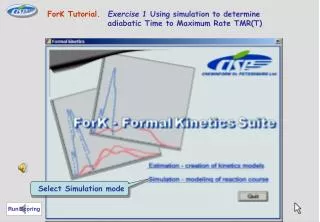
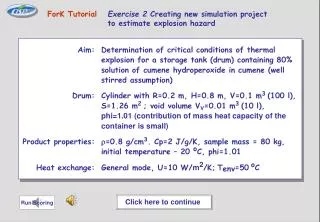
Click here to continue ForK TutorialExercise 2 Creating new simulation project to estimate explosion hazard Aim: Determination of critical conditions of thermal explosion for a storage tank (drum) containing 80% solution of cumene hydroperoxide in cumene (well stirred assumption) Drum: Cylinder with R=0.2 m, H=0.8 m, V=0.1 m3(100 l), S=1.26 m2; void volume VV=0.01 m3(10 l), phi=1.01 (contribution of mass heat capacity of the container is small) Product properties: =0.8 g/cm3. Cp=2 J/g/K, sample mass = 80 kg, initial temperature – 20 oC, phi=1.01 Heat exchange: General mode, U=10 W/m2/K;Tenv=50oC Run Scoring
Click here to continue ForK TutorialExercise 2 Creating new simulation project to estimate explosion hazard Kinetics: Complex reaction with 2 stages in parallel:(1) A B – N-order initiation reaction; stage rate – r1(2) A+B 2B – autocatalytic stage; stagerate - r2 Math model: (1): lnK01=20.4; n11=2; E1=102 kJ/mol; Q1=800 J/g (2)lnK02=23; n21=4; n22=3;E2=96 kJ/mol; Q2=1800 J/g
Preliminary adjustment: setting appropriate units
Defining the drum model Step 1. Defining general data Data that are to be assigned: 1. Response to be simulated (heat production) .01 1.01 72 2. Mass of a reagent and initial T 3. Void volume and pad gas data (in our case Pgo and Tgo are optional) 4. Mass specific heat and phi-factor
Defining the drum model Step 2. Defining Heat exchange mode Data that are to be assigned: 1. Heat exchange mode - General 1.26 2. Неat exchange Surface 3. Неat transfer coefficient 4. Environment temperature(on the “Env. Temperqature” tab)
60.1 60.0 59.9 50
Defining the drum model Step 3. Defining kinetic model Data that should be assigned: 1. Model structure 2. “Elementary” models for stages 3. Kinetic parameters Creating model of two stages in parallel(the model of fullautocatalysis) Stage 1 – of N-order type Stage 2 - Proto
Data that should be assigned: 1. Model structure 2. “Elementary” models for stages 3. Kinetic parameters 1. Creating model of two stages in parallel (the model of full autocatalysis) Stage 1 – of N-order type Stage 2 - Proto
Data that should be assigned: 1. Model structure 2. “Elementary” models for stages 3. Kinetic parameters 1. Creating model of two stages in parallel (the model of full autocatalysis) Stage 1 – of N-order type Stage 2 - Proto
Data that should be assigned: 1. Model structure 2. “Elementary” models for stages 3. Kinetic parameters 1. Creating model of two stages in parallel (the model of full autocatalysis) Stage 1 – of N-order type Stage 2 - Proto
Model created with the kinetic parameters for the second stage defined Data that should be assigned: 1. Model structure 2. “Elementary” models for stages 3. Kinetic parameters
Kinetic parameters for the first stage have been defined Data that should be assigned: 1. Model structure 2. “Elementary” models for stages 3. Kinetic parameters
Evaluating critical parameters of thermal explosion by using the “Effect of controls” option 1. Adjusting time interval for simulation
Note that max temperature rise (overheat) at initial environment T=60 C is very small. Next step is to elevate env. temperature
At Tenv=75 C overheat becomes much bigger. Continue to elevate Tenv till reaching explosion
There is pronounced thermal explosion at Tenv~77.5 C. More precise value can be obtained by varying Tenv with smaller step
The 2st Exercise is over. Press [Esc] to close presentation. If you have ForK installed we recommend to repeat this exercise by yourself. Now the complete project can be saved into a data volume for further use