CATALYST
In the study of crime-solving, how many individuals are typically involved, and do they always arrive at correct conclusions? This activity guides students through a crime scene puzzle, prompting initial observations, collaborative hypothesis building, and final analysis. Participants will explore evidence at specialized lab stations, refine their hypotheses, and reflect on their learning process. By gathering insights from different perspectives, students will consider the challenges of assigning guilt and the importance of teamwork in criminal investigations.

CATALYST
E N D
Presentation Transcript
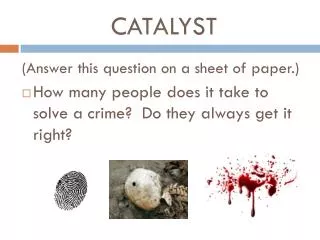
CATALYST (Answer this question on a sheet of paper.) • How many people does it take to solve a crime? Do they always get it right?
Reminders: • Contract / Dossier Due Monday • Start familiarizing yourself with the textbook this weekend!
Agenda: • Student Handbook • Crime Scene Puzzle
CRIME SCENE PUZZLE • Go to your specialized lab station and follow the directions at that station. (By the end you will have the following sections on your paperfor this activity: Initial Observations Post-Piecing Hypothesis Group Switch Observations Group Collaboration Hypothesis Reflection I Gather & Adjust Final Analysis
REFLECTION 1 • Given the information you have observed from your station and station nearest to you, are you comfortable naming a suspect or assigning guilt?
GATHER AND ADJUST • Take 1 minute to walk around to each lab station and make more observations. • Has your hypothesis changed?
FINAL ANALYSIS • Now that you have seen all the evidence, can you assign guilt?