Understanding the Atom: Structure, Models, and Early Theories in Physical Science
500 likes | 637 Views
This chapter explores the fundamental nature of atoms, the smallest units of matter, examining their structure, which includes protons, neutrons, and electrons. It reviews early atomic theories from philosophers like Democritus and Aristotle, leading up to John Dalton's contributions in the 1800s. The chapter highlights the evolution of atomic models, particularly Thomson's plum pudding model and Rutherford's nuclear model, including key experiments like the gold foil experiment. It also discusses atomic number, mass number, and the concept of isotopes, emphasizing the complexity of matter's building blocks.


Understanding the Atom: Structure, Models, and Early Theories in Physical Science
E N D
Presentation Transcript
Atoms Physical Science Chapter 4 Physical Science chapter 10
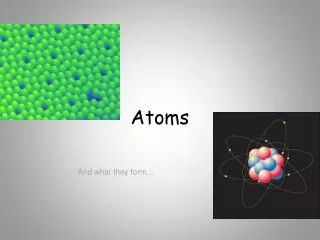
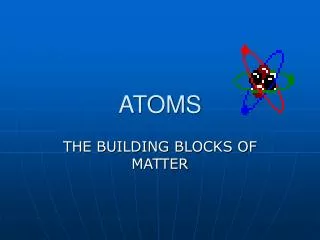
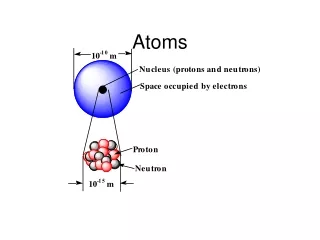
The atom • The atom – smallest piece of matter that has the properties of an element. • Made of • Protons • Neutrons • Electrons • If we split an atom, we no longer have a specific element • We can’t tell an oxygen proton apart from a carbon proton Physical Science chapter 10
Early atomic theory - Democritus • Greek philosopher about 400 B.C. • Gave us the word atom • Atomos - indivisible. • Thought • The world was made of empty space and particles called atoms. • There were different types of atoms for different types of materials. • Theory was not supported by experimental evidence. Physical Science chapter 10
Early atomic theory – Aristotle • Aristotle did not believe in atoms • thought matter was continuous • He was very influential, so Democritus’s theory was not accepted for many centuries. Physical Science chapter 10
17th century • People began to express doubts in Aristotle’s theory. • Experiments were being used to determine the validity of a theory. Physical Science chapter 10
John Dalton – early 1800s • Studied experimental observations of chemical reactions • Proposed explanation of these experimental results Physical Science chapter 10
Dalton’s Hypothesis • All matter is composed of very small particles called atoms. • All atoms of an element are exactly alike; atoms of different elements are very different. • Atoms cannot be subdivided, created, or destroyed. • Atoms unite with other atoms in simple ratios to form compounds • In chemical reactions, atoms are combined, separated, or rearranged. Physical Science chapter 10
Dalton’s theories • However, there some major exceptions to the rules. • Some elements can combine with each other in different proportions • H2O and H2O2 • Splitting atoms • Different atoms of the same element Physical Science chapter 10
Cathode rays and electrons • 1897 – J.J. Thomson tested cathode rays and discovered that they were electrons. • they had mass • they were negatively charged Physical Science chapter 10
Thomson’s plum pudding model • In this model, the raisins were the electrons and the pudding was the positive charge. • Sort of like chocolate chip cookie dough. • The chips are the electrons and the dough is the positive charge. • Explained the experiments that had been done so far. Physical Science chapter 10
Testing the plum pudding model • See page 117 • fired alpha particles at a very thin (a few atoms thick) sheet of gold foil. • They expected the particles to go right through because the spread out positive charge in the “pudding” wouldn’t be strong enough to deflect them. Physical Science chapter 10
What happened • Most of the particles did go right through without being deflected at all. • Some were deflected at large angles. • Ernest Rutherford explained it: • the positive charge on the atom was concentrated at a small core – now called the nucleus. Physical Science chapter 10
The atom as we now “know” it • The nucleus contains all of the positive charge and most of the mass. • The negatively charged electrons have very small mass and are located around the nucleus in the electron cloud. • Most of an atom is empty space. Physical Science chapter 10
Discuss • Compare and contrast Thomson’s atomic model with Rutherford’s atomic model. • How did the gold foil experiment lead to the conclusion that the atom has a nucleus? Physical Science chapter 10
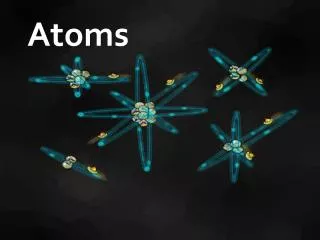
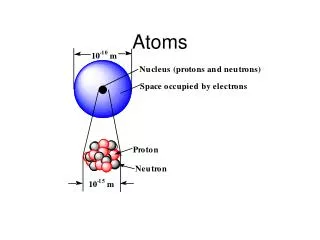
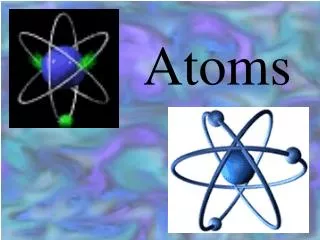
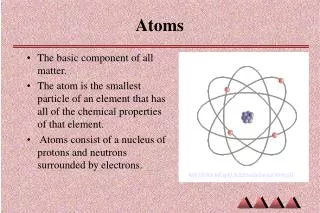
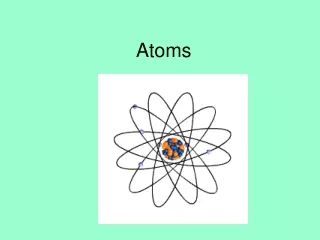
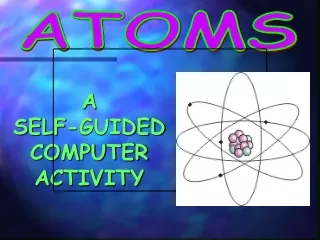
Atoms • Basic building blocks of matter • Smallest part that can be called an element • Made up of: • Nucleus – in the center • Protons – positively charged • Neutrons – neutral (no charge) • Electrons – around the nucleus and negatively charged Physical Science chapter 10
Mass and charge comparisons • A proton’s positive charge is equal to an electron’s negative charge. • A proton and a neutron have about the same mass. • An electron has a mass that is about 1/2000 the mass of a proton • Electrons are much smaller! They are so small that their mass is negligible. Physical Science chapter 10
Atomic number (Z) • Given on the periodic table. • The atomic number of an atom is the number of protons it has. • Defines what element an atom is • It is also the number of electrons the atom has. • Since an atom has an equal number of positive protons and negative electrons, the whole atom is electrically neutral. Physical Science chapter 10
Mass number (A) • the number of particles in the nucleus of an atom. • In other words, the sum of the number of protons and the number of neutrons. Physical Science chapter 10
Calculating the number of neutrons • To find the number of neutrons, just subtract the atomic number from the mass number. Physical Science chapter 10
Isotopes • Atoms of the same element that have different numbers of neutrons. • All the isotopes of an atom have the same number of protons and electrons, it is only the number of neutrons that is different. • All the isotopes of an atom are chemically the same, even though they differ in mass. Physical Science chapter 10
Different isotopes • To distinguish between the two types of neon isotopes, we can write neon-20 and neon-21. Physical Science chapter 10
Discuss • Read the “Why It Matters” section on page 123. • Discuss it with your groups – including the critical thinking question. Physical Science chapter 10
Atomic mass • A proton or a neutron has a mass of about 1.7 x 10⁻²⁷ kg. • This is a very small number, so it is not very convenient to write or work with. • Instead, we use atomic mass units (amu). • Also called unified atomic mass units (u) Physical Science chapter 10
Atomic mass units • 1 amuis defined as one-twelfth the mass of a carbon atom with 6 protons and 6 neutrons. • Since the mass of electrons are negligible, a proton or a neutron has a mass of about 1 amu. Physical Science chapter 10
Atomic mass • On the periodic table, the atomic masses listed are usually not whole numbers. • This is because atoms have different isotopes. • So, the masses given on the table are average masses. Physical Science chapter 10
Example • Neon has isotopes with mass numbers of 20 and 21. • The atomic mass on the periodic table is given as 20.179. • This tells us that most neon isotopes have a mass number of 20. • How many neutrons are in each neon isotope? Physical Science chapter 10
Weighted averages • We then use a weighted average to find the average mass of an atom of a given element. • This is called the average atomic mass or just atomic mass. Physical Science chapter 10
The Mole • SI unit for amount of substance • Abbreviated mol • A counting unit • 6.022 x 10²³ particles • Avogadro’s number • Based on carbon-12, 12 g of C-12 contains 1 mol of atoms Physical Science chapter 10
Molar mass • The mass of 1 mol of a pure substance • Units: g/mol • Numerically equal to the atomic mass in amu • On the periodic table the number with a decimal is the atomic mass in amu AND the molar mass in g/mol Physical Science chapter 10
conversions • Grams to moles or moles to grams • Use the molar mass Physical Science chapter 10
Example • What is the mass in grams of 5.60 mol of sulfur? Physical Science chapter 10
Example • How many moles of carbon are in a sample with a mass of 567 g? Physical Science chapter 10
You try • How many moles are in 0.255 g of zinc? Physical Science chapter 10
You try • What is the mass of 1.21 mol of helium? Physical Science chapter 10
Compounds • Also have molar mass • Example: What is the molar mass of carbon dioxide, CO2? • You try: What is the molar mass of hydrogen peroxide, H2O2? Physical Science chapter 10
Bohr model • Neils Bohr – 1913 • Electrons orbit the nucleus like planets orbit the sun Physical Science chapter 10
Energy Levels • Electrons near the nucleus have low energy. • Electrons farther from the nucleus have higher energy. • The electrons are in levels – like floors in a building. • See page 128 • Electrons can be on any level, but they cannot be between levels. Physical Science chapter 10
Energy levels • The levels are not equally spaced, and they cannot all hold the same number of electrons. • The lowest level can only hold 2 electrons. • The second level can hold 8 electrons. • The third level can hold 18 electrons. Physical Science chapter 10
Valence electrons • Electrons in the outer energy level of an atom • Determine the chemical properties of an atom Physical Science chapter 10
Electron cloud model • Represents the probable locations of electrons within an atom. • We never know for sure exactly where an electron is because it is so small and it moves so fast. Physical Science chapter 10
Orbitals • Spaces in each energy level than electrons occupy • Each orbital can hold two electrons Physical Science chapter 10
S orbital • Spherical • Each energy level has one • Can hold 2 electrons Physical Science chapter 10
P orbital • Dumbbell shaped • Found in level 2 and up • Can have three orientations in space • Each p orbital can hold 2 electrons • Total of 6 electrons can be in the p orbitals in an energy level Physical Science chapter 10
d and f orbitals • More complex shapes • There are 5 d orbitals and 7 f orbitals • d start in level 3 • f start in level 4 Physical Science chapter 10
Electron Energy States • Ground state – Lowest energy state of an electron • Excited state – higher energy state than the ground state Physical Science chapter 10
Electron Transitions • Energy gain • Photon absorbed • Electron “rides up the elevator” to a higher energy state • Energy loss • Photon emitted • Electron “rides down the elevator” to a lower energy level • The amount of energy in the photon determines how many levels the electron moves Physical Science chapter 10
Spectral Analysis • Each element has a unique atomic structure and a unique set of energy levels. • Therefore, different atoms emit photons of different energy. • Photons of different energy have different wavelengths (colors). • An element can be identified by the colors it emits as its electrons lose energy. Physical Science chapter 10
Sample Spectra Physical Science chapter 10
Discuss • State two key features of the modern model of the atom. • Describe what happens when an electron jumps from one energy level to another. Physical Science chapter 10