Download
1 / 11
110 likes | 240 Views
Explore the process of determining the molecular shape of carbon dioxide (CO2) using Lewis dot structures and VSEPR (Valence Shell Electron Pair Repulsion) theory in this quick 5-minute activity. Begin with drawing the electron-dot structure for CO2 and arranging the electron groups around the central atom to minimize repulsion. As we follow the steps outlined in the VSEPR modeling activity, predict the molecule's linear shape and confirm its bond angles, leading to an understanding of polarity.

E N D
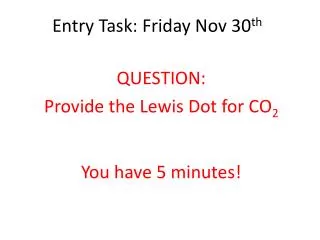
Entry Task: Friday Nov 30th QUESTION: Provide the Lewis Dot for CO2 You have 5 minutes!
Guide to Predicting Molecular Shape (VSEPR Theory) STEP 1 Write the electron-dot structure. STEP 2 Arrange the electron groups around the central atom to minimize repulsion. STEP 3 Use the atoms bonded to the central atom to determine the shape of the molecule.
Linear • 2 atoms attached to center atom 0 unshared pairs (lone pairs) .. .. :Cl: Be: Cl: .. .. • Bond angle = 180o • Type: EX2 • Ex. : BeCl2
Trigonal Planar • 3 atoms attached to center atom • 0 lone pairs • Bond angle = 120o • Type: EX3 • Ex. : BF3
Tetrahedral • 4 atoms attached to center atom • 0 lone pairs • Bond angle = 109.5o • Type: EX4 • Ex. : CH4
Trigonal Pyramidal • 3 atoms attached to center atom • 1 lone pair • Bond angle = 107o • Type: EX3 • Ex. : NH3 ● ●
bent O H H Bent • 2 atoms attached to center atom • 2 lone pairs • Bond angle = • General: E2X • Ex. : H2O ● ● ● ●
Cl Cl Cl P Cl Cl Trigonal Bipyramidal • 5 atoms attached to center atom • 0 lone pairs • Bond angle = • equatorial -> 120o • axial -> 90o • Type: EX5 • Ex. : PCl5
F F F S F F F Octahedral • 6 atoms attached to center atom • 0 lone pairs • Bond angle = 90o • Type: EX6 • Ex. : SF6
Part 2- Construct the following molecules Do the electron dot arrangement Do the Lewis structure Provide a drawing/ name of molecular shape After section 5 go back and predict whether the molecule is polar or non polar