Optimizing Clorox Solutions for Enhanced Bacterial Reduction and Tissue Dissolution
20 likes | 146 Views
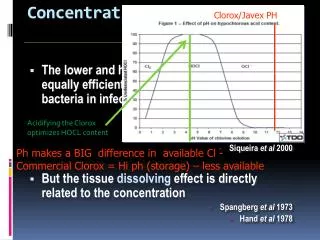
This guide explores the concentration efficacy of Clorox (0.5% and 5.25%) in reducing bacterial counts in infected root canals. Both concentrations prove equally effective in bacterial reduction, but the tissue-dissolving effect heavily depends on concentration levels. The key to improving the efficacy of Clorox is adjusting the pH to optimize hypochlorous acid (HOCl) availability. Using a modified sodium hypochlorite (NaOCl) formula lowers pH, increases HOCl availability, and reduces toxicity. A recommended recipe for a fresh, effective solution is provided for each treatment.


Optimizing Clorox Solutions for Enhanced Bacterial Reduction and Tissue Dissolution
E N D
Presentation Transcript
Clorox/Javex PH Concentration: 0.5% and 5.25% • The lower and higher concentrations are equally efficient in reducing the number of bacteria in infected RC • Spangberget al 1973 • Cvecket al 1976b • Bystrom and Sundqvist 1985 • Siqueiraet al 2000 • But the tissue dissolving effect is directly related to the concentration • Spangberget al 1973 • Hand et al 1978 Acidifying the Clorox optimizes HOCL content Why is this? Ph makes a BIG difference in available Cl - Commercial Clorox = Hi ph (storage) – less available
How Do We compensate ? • Use regular NaOCl for C&S - solvency • Use “modified” formula for final bacteriocidal rinse. Modified NaOCl • Lowers the Ph – increases available Cl- (HOCL) • Lowers TOXICITY Formula • 50 ml distilled water • 0.5 ml NaOCl (Clorox) • 0.5 ml Acetic acid (White Vinegar) • Mixed fresh for every treatment - 2 hr shelf life