Download
1 / 1
10 likes | 141 Views
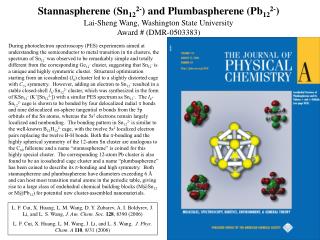
Characterization of Stannaspherene and Endohedral Stannaspherene. Lai-Sheng Wang, Department of Physics, Washington State University 2710 University Drive, Richland, WA 99354.

E N D
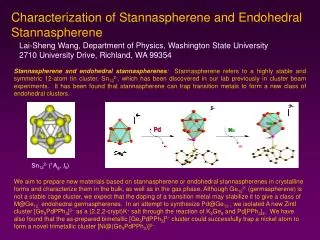
Characterization of Stannaspherene and Endohedral Stannaspherene Lai-Sheng Wang, Department of Physics, Washington State University 2710 University Drive, Richland, WA 99354 Stannaspherene and endohedral stannaspherenes: Stannaspherene refers to a highly stable and symmetric 12-atom tin cluster, Sn122-, which has been discovered in our lab previously in cluster beam experiments. It has been found that stannaspherene can trap transition metals to form a new class of endohedral clusters. Sn122- (1Ag, Ih) We aim to prepare new materials based on stannaspherene or endohedral stannaspherenes in crystalline forms and characterize them in the bulk, as well as in the gas phase. Although Ge122- (germaspherene) is not a stable cage cluster, we expect that the doping of a transition metal may stabilize it to give a class of M@Ge12- endohedral germaspherenes. In an attempt to synthesize Pd@Ge12-, we isolated A new Zintl cluster [Ge9PdPPh3]3– as a (2,2,2-crypt)K+ salt through the reaction of K4Ge9 and Pd[PPh3]4. We have also found that the as-prepared bimetallic [Ge9PdPPh3]3– cluster could successfully trap a nickel atom to form a novel trimetallic cluster [Ni@(Ge9PdPPh3)]2–.