Download
1 / 36
360 likes | 456 Views
Explore how social practices influence genetic diversity with a focus on mtDNA and Y chromosome markers. Learn about residence patterns, sex-biased migrations, polygyny, and upward social mobility, providing insights into prehistoric societies.

E N D
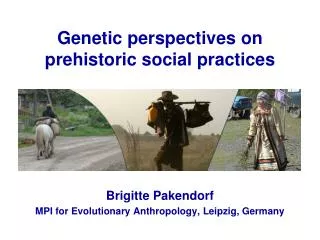
Genetic perspectives on prehistoric social practices Brigitte Pakendorf MPI for Evolutionary Anthropology, Leipzig, Germany
Social practices and genetics? • Social practices can have an effect on the number of offspring a person has can be detected with genetic methods • Holds especially true for social practices that affect one of the sexes more than the other: polygyny, residency patterns, ‘upward’ social mobility
Benefits of mtDNA and Y chromosome • exclusively maternal and paternal inheritance, respectively • no recombination
The benefits of studying mtDNA and Y-chromosomal markers: mtDNA Y (non-sex) chromosome Y-chromosome
Benefits of mtDNA and Y chromosome • mutations accumulate with time alone • possibility of defining related lineages (= haplogroups), i.e. shared mutations indicate shared ancestry (if mutations are rare!!) • complementary studies of population history (female vs male) are possible
Types of mutations • SNPs = Single Nucleotide Polymorphisms – individual base changes (e.g. T C):slow mutation rate • STRs = Short Tandem Repeats – change in number of repeat sequence of bases (e.g. [AGCT]16 [AGCT]17):very high mutation rate
Socially conditioned prehistoric events • Residence patterns • Sex-biased migrations • Polygamy • ‘Upward’ social mobility
1) Residence patterns • Matrilocality: the groom settles with the wife’s family after marriage mixing of Y-chromosomes, mtDNA’s stay put • Patrilocality: the bride settles with the husband’s family after marriage mixing of mtDNA’s, Y-chromosomes stay put • Prediction: in patrilocal groups, mtDNA diversity should be higher than Y-chromosomal diversity, and vice versa for matrilocal groups
Genetic diversity in Thailand hill tribes Oota et al. (2001) Nature Genetics 29: 20 - 21
2) Sex-biased migrations: Pacific Melanesian mtDNA Asian mtDNA Other mtDNA Kayser et al. (2006) Mol Biol Evol. 23: 2234-44. Map courtesy of the University of Texas Libraries, The University of Texas at Austin.
2) Sex-biased migrations: Pacific Melanesian Y-DNA Asian Y-DNA Other Y-DNA Kayser et al. (2006) Mol Biol Evol. 23: 2234-44. Map courtesy of the University of Texas Libraries, The University of Texas at Austin.
2) Sex-biased migrations: Pacific Polynesian mtDNA: 94% Asian origin Polynesian Y: 66% Melanesian origin • Potentially due to matrilocality of Austronesian- speakers • Melanesian men incorporated into Austronesian- speaking society prior to further migration to Polynesia Kayser et al. (2006) Mol Biol Evol. 23: 2234-44.
2) Sex-biased migrations: male conquerors • Closely-related Y-chromosomal lineage identified in 16 Central Asian populations Zerjal et al. (2003): Am J Hum Gen. 72: 717–721
2) Sex-biased migrations: male conquerors Zerjal et al. (2003): Am J Hum Gen. 72: 717–721
2) Sex-biased migrations: male conquerors • Closely-related Y-chromosomal lineage identified in 16 Central Asian populations • Dated to ~ 700-1300 years BP • Most likely origin in Mongolia (highest diversity) Zerjal et al. (2003): Am J Hum Gen. 72: 717–721
2) Sex-biased migrations: male conquerors Distribution of Mongolian Y-chromosomal lineage; shaded area = extent of Mongol Empire at time of Chinggis Khan’s death Zerjal et al. (2003): Am J Hum Gen. 72: 717–721
2) Sex-biased migrations: male conquerors • Y-lineage with one male ancestor ~ 1000 years ago • widespread in Central Asia spread with Mongol Empire • ruling clans = Chinggis Khan’s sons and grandsons ‘Chinggis Khan’s Y-chromosome’ Zerjal et al. (2003): Am J Hum Gen. 72: 717–721
3) Polygamy (polygyny) • Polygyny: few men have many wives, and many men may have no wife at all • Prediction: (severely) reduced Y-chromosomal diversity
Y-chromosomal SNP frequencies in New Guinea Kayser et al. (2003): Am J Hum Genet 72:281-302
Y-chromosomal and mtDNA diversity, West New Guinea Kayser et al. (2003): Am J Hum Genet 72:281-302
Social practices of Bantu-speaking groups? • Can genetic studies inform us about the prehistoric social practices of Bantu-speaking groups (intermarriage with hunter-gathering populations, patrilocality)?
Upward social mobility • Ethnographic assumption: agriculturalist men may marry hunter-gatherer women, but not vice versa • Prediction: introgression of ‘hunter-gatherer mtDNA’ but not Y-chromosomes in agricultural populations
Upward social mobility Pereira et al. (2001): Ann Hum Genet 65: 439-458 Salas et al. (2002): Am J Hum Genet. 71: 1082–1111
Upward social mobility Pereira et al. (2001): Ann Hum Genet 65: 439-458 Salas et al. (2002): Am J Hum Genet. 71: 1082–1111 Wood et al. (2005): Eur J Hum Genet 13: 867-876
Upward social mobility • Potentially intriguing finding:1) the social ideal is not always adhered to2) shift of language and identity of small groups of Khoisan-speakers in Southern Africa
Upward social mobility Pereira et al. (2001): Ann Hum Genet 65: 439-458 Salas et al. (2002): Am J Hum Genet. 71: 1082–1111 Wood et al. (2005): Eur J Hum Genet 13: 867-876
Upward social mobility Pereira et al. (2001): Ann Hum Genet 65: 439-458 Salas et al. (2002): Am J Hum Genet. 71: 1082–1111 Wood et al. (2005): Eur J Hum Genet 13: 867-876
Upward social mobility • Caveat: groups not really comparable South African Nguni populations (Zulus, Xhosa) are known to have been in close contact with Khoisan speakers (‘borrowing’ of clicks)
Patrilocality in Bantu-speakers? • Prediction: in patrilocal groups, mtDNA diversity should be higher than Y-chromosomal diversity
Haplogroup diversity values in some Bantu-speaking groups Tishkoff et al. (2007): Mol Biol Evol 24: 2180-2195; Pereira et al. (2001): Ann Hum Genet 65: 439-458 Salas et al. (2002): Am J Hum Genet. 71: 1082–1111; Wood et al. (2005): Eur J Hum Genet 13: 867-876 Quintana-Murci et al. (2008): PNAS 105: 1596–1601; De Filippo et al. unpublished
Social practices of Bantu-speaking groups? • Reduced Y-chromosomal diversity appears indicative of patrilocal post-marital residence
Data are not comparable • ‘West Central Africa’mtDNA = 20 groups from Cameroon and Gabon Y-chromosome = 3 groups from Cameroon • ‘Southern Africa’mtDNA = ~ 20 different populations from Mozambique Y-chromosome = Sotho-Tswana, Zulu and Xhosa from South Africa
Data are not comparable • practically no comparable data available for mtDNA and Y-chromosome in the same Bantu-speaking groups
Conclusions • Genetic analyses can provide some insights into prehistoric social practices • These may be of help for historical linguists in search of explanations for patterns of linguistic diversity (e.g. contact-induced change) • However, comparable studies of both mtDNA and Y-chromosomal diversity in ethno-linguistically well-defined groups are needed
Acknowledgements • Cesare de Filippo for Bisa and Kunda data • Mark Stoneking for discussion