
Choosing the Right Family Planning Method: Guidance for Clients with a Method in Mind
This page assists clients who already have a specific family planning method in mind to evaluate if it meets their needs and circumstances. It encourages open communication about the method's effectiveness, potential side effects, and suitability based on the client's lifestyle. Key considerations include the need for protection against STIs and HIV/AIDS, the importance of remembering to take a pill or attending regular appointments, and discussing alternatives if the client feels uncertain. Let's explore how the chosen method aligns with their goals and preferences.

Choosing the Right Family Planning Method: Guidance for Clients with a Method in Mind
E N D
Presentation Transcript
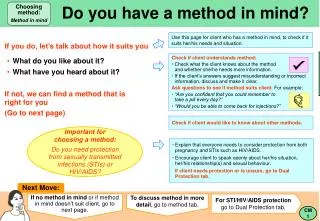
Do you have a method in mind? Choosing method: Method in mind Use this page for client who has a method in mind, to check if it suits her/his needs and situation. If you do, let’s talk about how it suits you • What do you like about it? • What have you heard about it? • Check if client understands method: • Check what the client knows about the method and whether she/he needs more information. • If the client’s answers suggest misunderstanding or incorrect information, discuss and make it clear. • Ask questions tosee if method suitsclient.For example: • “Are you confident that you could remember to take a pill every day?” • “Would you be able to come back for injections?” Choosing Method If not, we can find a method that is right for you (Go to next page) Check if client would like to know about other methods. Important for choosing a method: Do you need protection from sexually transmitted infections (STIs) or HIV/AIDS? • Explain that everyone needs to consider protection from both pregnancy and STIs such as HIV/AIDS. • Encourage client to speak openly about her/his situation, her/his relationship(s) and sexual behaviour. • If client needs protection or is unsure, go to Dual Protection tab. Next Move: If no method in mind or if method in mind doesn’t suit client, go to next page. To discuss method in more detail, go to method tab. For STI/HIV/AIDS protectiongo to Dual Protection tab. CM1
You can find a methodright for you • No method in mind? We can discuss: • Your experiences with family planning • What you have heard about family planning methods • Your plans for having children • Protection from sexually transmitted infections (STIs) or HIV/AIDS • Your partner’s or family’s attitudes • Other needs and concerns Now let’s discuss how a method can meet your needs
You can find a method right for you Choosing method: NO method in mind • Helping client with no method in mind to make a decision: • Use this page to help client think about her/his situation and life and what seems most important about a method. • Discussing some of the topics at left can help the client consider different methods. You can say: • “Here are some things to consider when choosing a family planning method.” • “What is most important to you?” • “The choice is yours. I want you to be happy with your choice.” • No method in mind? We can discuss: • Your experiences with family planning • What you have heard about family planning methods • Your plans for having children • Protection from sexually transmitted infections (STIs) or HIV/AIDS • Your partner’s or family’s attitudes • Other needs and concerns • Explain that everyone needs to consider protection from both pregnancy and STIs such as HIV/AIDS. • Encourage client to speak openly about her/his situation, her/his relationship(s) and sexual behaviour. • If client needs protection or is unsure, go to Dual Protection tab. • The Special Needs tab or Appendices may help. Next Move: Go to next page to discuss what methods could suit the client’s needs. CM2
Comparing methods Female sterilization Vasectomy IMPORTANT!Only condoms protect against both pregnancy and STIs/HIV/AIDS Most effective and nothing to remember. Very effective but must be carefully used. Effective but must be carefully used. Fewer side-effects, permanent: Fewer side-effects: Fewer side-effects: LAM Fertility awareness-based methods Male and female condom Vaginal methods More side-effects: More side-effects: IUD Pills Injectables Implants
Comparing methods Choosing method • Use this page to help client compare methods and narrow down choices. • Important considerations: • Effectiveness: Depends on how much the client has to do or remember. The most effective methods require no repeated action. You can ask: • “How important is it to you that you don’t get pregnant now?” • “Do you think you can use a method that requires repeated action (such as taking a pill or getting an injection)?” • Side-effects: Side-effects of hormonal methods (pills, injectables and implants) are common at first, but may go away after a few months. The IUD may also bother some women. Discuss how client would feel, for example: “How would you feel if this method changed your monthly bleeding?” • Permanent, long- or short-term: Sterilization and vasectomy are permanent. IUD and implants can be left in place for many years. • Protection from HIV/AIDS and other STIs: Condom is the only method that protects against STIs. To help client consider options and risk, go to next page. • If client finds it hard to choose: • Find out what the client needs: To talk with partner? More information? Talk with a user? Think about it more? • Explain to clients that they can try a method for a few weeks or months to see how they like it (except sterilization, vasectomy and implants). For more information on comparing methods, see Appendices 2 and 3. Next Move: To discuss a method in more detail, go to method tab. For STI/HIV/AIDS protection,go to next page. CM3
Ways to avoid both pregnancy & STIs/HIV/AIDS You can decide Options using family planning: Condoms Condoms AND Another family planning method Any family planning method WITH Uninfected partner For example: Female condoms Male condoms OR AND Some other options: AND for added protection from STIs/HIV/AIDS... Reduce your number of sexual partners: one uninfected partner is safest Other safe forms of intimacy Delay or avoid having sex