Understanding Dilations: Scale Factors Greater and Less Than One
This guide delves into the concept of dilations in geometry, illustrating how to perform dilations with scale factors greater than 1 and less than 1. Using practical examples, it explains the process of finding the dilated coordinates for triangles and quadrilaterals, verifies the similarity of figures before and after dilation, and provides step-by-step solutions for practice problems. Ideal for students seeking a clear understanding of dilations and their properties, this resource makes geometry accessible and engaging.

Understanding Dilations: Scale Factors Greater and Less Than One
E N D
Presentation Transcript
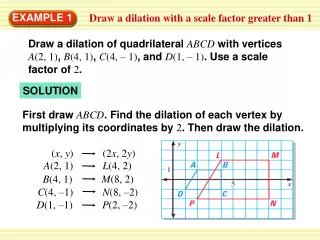
(x, y) (2x, 2y) A(2, 1) L(4, 2) B(4, 1) M(8, 2) C(4, –1) N(8, –2) D(1, –1) P(2, –2) EXAMPLE 1 Draw a dilation with a scale factor greater than 1 Draw a dilation of quadrilateralABCDwith verticesA(2, 1), B(4, 1), C(4, – 1), andD(1, – 1). Use a scale factor of2. SOLUTION First draw ABCD. Find the dilation of each vertex by multiplying its coordinates by 2. Then draw the dilation.
A triangle has the vertices A(4,– 4),B(8, 2), and C(8,– 4). The image of ABCafter a dilation with a scale factor of is DEF. SketchABCandDEF. Verify that ABCand DEFare similar. 1 a. 2 b. EXAMPLE 2 Verify that a figure is similar to its dilation
a. The scale factor is less than one, so the dilation is a reduction. 1 1 2 2 A(4, – 4) D(2, – 2) y x, (x, y) C(8, – 4) F(4, – 2) B(8, 2) E(4, 1) EXAMPLE 2 Verify that a figure is similar to its dilation SOLUTION
b. Because Cand Fare both right angles, C F. Show that the lengths of the sides that include Cand Fare proportional. Find the horizontal and vertical lengths from the coordinate plane. ? = AC BC = 4 6 EF DF So, the lengths of the sides that include Cand Fare proportional. 2 3 ANSWER Therefore, ABCDEFby the SAS Similarity Theorem. ~ EXAMPLE 2 Verify that a figure is similar to its dilation
Find the coordinates of L, M, and N so that LMN is a dilation of PQR with a scale factor of k. Sketch PQR and LMN. x, y = 4x , 4y P (–2, –1) = L (–8, –4) M (– 4, 0) Q (–1, 0) = R (0, –1) = N (0, –4) for Examples 1 and 2 GUIDED PRACTICE 1. P(–2, 21), Q(–1, 0), R(0, –1); k = 4 SOLUTION Find the dilation of each vertex by multiplying its coordinates by 4. ANSWER
2 2 5 5 x, y x , y P(5, –5) L (2, –2) Q(10,–2) M (4, –2) R (10, 5) N (4, 2) for Examples 1 and 2 GUIDED PRACTICE 2. P(5, –5), Q(10, –5), R(10, 5); k = 0.4 SOLUTION Find the dilation of each vertex by multiplying its coordinates by 0.4. The scale is less than one, so the dilation is a reduction. ANSWER