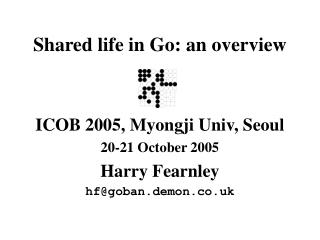
Shared life in Go: an overview
510 likes | 619 Views
This presentation provides an overview of the ongoing work on constructing a full catalog/database of Seki and Bik in Shared Life scenarios in the game of Go. The talk includes discussions on the challenges, methods, and potential applications of this research.


Shared life in Go: an overview
E N D
Presentation Transcript
Shared life in Go: an overview ICOB 2005, Myongji Univ, Seoul 20-21 October 2005 Harry Fearnley hf@goban.demon.co.uk
Outline • Catalogues/databases – a “good thing” • What work done already? • How to do it: e.g. hanezeki/ jeochim bik • Much more work needed • Show some fun, new, seki/ bik
Structure (1) • Reduced paper – 30% • Abstract, Introduction • Goal: Full catalogue/database of seki/ bik • Catalogues very desirable – computers & people • Limited work – manual, not computer search • Chess research (Bratko & Michie) – lessons? • Independent life – compare with seki
Structure (2) • Shared life (seki/ bik/ shuang huo) • No capture • Capture: (generalized) nakade/ chijung • Capture, Immediate Re-capture (CIR) • Snapback/ hwangyeok, hanezeki/ jeochim bik, other • Capture: other • Conclusions, extensions, and further work
Abstract • Many distinct types of seki • Towards a full classification . . . • Capture – includes “capture possible, but not desirable” – e.g. hanezeki/ jeochim bik • What components are available? • Goal: systematic construction of full catalogue/database of seki/bik • Sketch way forward & outline some results
Introduction (1) • Catalogues: existing – e.g. • joseki/ jungsuk ? – high level, incomplete catalogue • Combinatorial Games Theory (CGT): “rooms”, “corridors” – amateur beats pro in selected endgame! Low level, “complete” – points values … • Catalogues: eyes/liberties – new, not yet done …
Introduction (2) • Eyes, liberties, & cycles/ “loopy” positions (ko/ pae, etc.) • Use of catalogues: • Help humans play (1 game/1,000?), and learn (perhaps computer-assistant) • Build into programs – more “knowledge” • Train/test computer programs – improve algorithms • Discover new things! See later …
Introduction (3) • Chess – Bratko & Michie, 1980. (King and Rook) v (King and Knight) – KRKN– endgame • Collaboration: • AI researchers • Computers – to create/supply database • Chess masters • Result: • Change rules of Chess – # moves without capture • Heuristics: corrected, and much smaller: 1 book 1 page! • Go – nothing comparable yet … but Dosetsu’s (1713) 16-stone capture now manually extended to 17-stones [Pauli2004a]
Introduction (4) • Assumptions • Chinese method of counting • Normally “terminal” positions – unsafe/unwise for either player to play • Can remove/alter these 2 assumptions fairly easily • No initial cycles/ “loopy” positions – ko/ pae, chosei/ jangsaeng, etc – harder to remove • … but allow non-initial cycles – not much studied
Independent Life (1) • Independent life simpler than seki – fewer possible configurations • No catalogue of all configurations of 2-eyed groups • Some results known – e.g. 1-6 groups [Fearnley2003], and Hungerink’s 31-group (max possible on 19x19) • Importance: only topology (relationships between groups) – not size, or shape
Shared life – seki/ bik (1) • More complicated than independent life • Liberty sharing: • No capture possible – all groups share liberties with (some) other groups in same seki/ bik • Capture possible – often true, some exceptions • Liberties shared by many groups/chains • Non-symmetric liberties
Shared life – seki/ bik (2)Fig 20: Flower-6 Fig 31a: Linked seki (Shimada)
Shared life – seki/ bik (3)Fig 2: 2-1 shared Fig 3: 2-2 shared Fig 4: 3-1 shared Fig 5: Non-removable threatsFig 6a Fig 6b Fig 6c: complex Fig 6d: complexFig 6: Non-symmetric “shared” liberties
No Capture (1) • Gurvich & Gol’berg [Gurvich1981]: • Only fully connected seki/ bik – not as Fig 4. They use graphs and seki matrices • Also some very unstable sekis – captures possible, but group sizes very finely balanced – … left as seki • No published catalogue • Hungerink 129-chain seki (Fig 7)
No Capture (2)Fig 7: Hungerink’s 129-chain seki/ bik(max on 19x19?)
Seki/ bik with Capture • Fight for eyes, and liberties – (usually) not points • Many varieties of seki/ bik – capture gives … e.g. • Two eyes with ko/ pae • One eye + some liberties (maybe ko, various) • No eyes + some liberties (maybe ko, various) … • Initial capture – immediate, or delayed? • Delayed capture not fully catalogued yet • Need to count number, and size, of eyes; number, and type (normal/ ko/ …), of liberties
Simple capture – nakade/ chijung (1)Build from components – also hanezeki/ jeochim bikCentre/edge Corner (different)
Simple capture – nakade/ chijung (2)Corner components: 1-1 emptyWhite needs extra “external” liberty
Simple capture – nakade/ chijung (3) Complex corner nakade/ chijung components
Simple capture – nakade/ chijung (4) • Simple seki/ bik with nakade/ chijung captures … • Groups must have captures of same value
Simple capture – nakade/ chijung (5) • [Fearnley2005b] : All seki with one Black group versus several White groups • Built from components seen earlier • Captures give 0, 1, 2, 3, 4, 4 (or 1 + ko/pae), 6, 6 (or 1 + ko), 7, 9 (or 3 + ko), and 11 liberties/ hwallo • Some seki unstable – one player can safely capture stones – other cannot
Simple capture – nakade/ chijung (6)Fig 8: Equal 1-3: unstable (White + 14)Fig 9: Equal 2-4 – possible unstable (White + 11) [Feldmann2005]
Simple capture – nakade/ chijung (7)Fig 10: Equal 4-6: unstable (White + 17)Fig 11: Equal 7-9: seki/Black dead (ko/pae)
Simple capture – nakade/ chijung (8)Fig 12: Equal 9-11: seki/ White dead (ko/ pae)Fig 13: Seki: Largest centre/edge combo (Feldmann2005)
Simple capture – nakade/ chijung (9)Not seki, but better if opponent plays first!Fig 14a: One-or-two-die Fig 14b: Four-or-five-die (well known) (new -- 1 of 4 centre/edge)
Simple capture – nakade/ chijung (10)Fig 15: Unequal 1-2-4: terminal (Feldmann2005)Fig 16: Unequal 3-4-6: terminal
Simple capture – nakade/ chijung (11)Fig 17: Unequal seki/ Black dies (ko/ pae)Fig 18: 2 black v 3 white: 1-3 : seki
Simple capture – nakade/ chijung (12) • [Fearnley2005b]: more multiple group combinations • Further work needed: • Complete m black versus n white … • Complex corner nakade/ chijung • More complicated topologies • Role of suicide, if Chinese rules
Capture, Immediate Recapture (CIR) • Two-sided, mutual, capture possible • … Recapture: • Immediate: CIR • Delayed: CDR – Capture, Delayed Recapture • CIR • Snapback (uttegaeshi/ hwangyeok) – except as special, below • Hanezeki/ jeochim bik – in-line capture/recapture • Special snapback – Figs 19 & 20, and [Fearnley2004]
CIR – Snapback/ Hwangyeok (1)Fig 19: pre 1-eye Fig 20: Flower 6 Fig 21: in-line Fig 22 diagonal Fig 23: ko-for-lifeFig 24: pre-snapback Fig 25: snapback Fig 26: TSM Fig 27: half-snapback
CIR – Snapback/ Hwangyeok (2) • No systematic study of seki with snapback • In-line – Fig 21 – no use in creating seki; diagonal – Figs 22-23 – useful • Special property of corner – Figs 24-27 • Related to CDR – discussed later • Full catalogue of eyes + liberties in snapback – should be easy …
CIR – hanezeki/ jeochim bik (1)Fig 28: XuanXuan QiJing (1347) Fig 29: Shimada (1958) • Known 650+ years – XuanXuan QiJing/ Hyun hyun ki kyung (1347). Others known – e.g. Shimada’s Igo no Suri (1958), and Igo Hatsuyoron (1713)
CIR – hanezeki/ jeochim bik (2)Fig 30: Igo Hatsuyoron (1713)Wiki Balyangron
CIR – hanezeki/ jeochim bik (3) • Generalize shapes in Figs 28-30 • Two components: • Ordinary nakade/ chijung • Special mutual-capture component • Equivalent to nakade for White, but if Black captures, White can re-capture • Capture/re-capture must be bad for Black • … may depend on size of first captured group
CIR – hanezeki/ jeochim bik (4) • [Fearnley2005a] – complete analysis • 130 configurations – 20 corner only • Extra 87 with ko/ pae – 28 corner only • Wrap-around not counted • Nakade of 3-8 stone captures. Hanezeki with 5-6 stones unusual – likely to have ko
CIR – hanezeki/ jeochim bik (5)Fig 32: Hat-4: all shapes/sizes Fig 33 – Hat-4 other captures orientations
CIR – hanezeki/ jeochim bik (6) • Hat 4 – example • Fig 32: • a, b1, b2, b3: hanezeki with ko • c-f: simple hanezeki • Fig 33: • Top: • a: Black wins – not hanezeki • b-f: normal hanezeki (no ko!) • Middle & bottom: same as Fig 32
CIR – hanezeki/ jeochim bik (7) • Construction: 3-way combine – each nakade capture (including complex corner nakade), in all orientations, with each distinct recapturable component. • Note: many recapturable components (almost) equivalent – Fig 30 (Igo Hatsuyoron), 20-stone capture same as 2-stone, or 3-stone capture …
CIR – hanezeki/ jeochim bik (8)Fig 30: Igo Hatsuyoron (1713)Wiki Balyangron
CIR – hanezeki/ jeochim bik (9)Fig 34: Smallest “largest” hanezeki? • Can usually create hanezeki with a-d (1-5 stone) • Need e (or f) for one orientation of hammer-5, and all flower-6 (hana roku/ maehwayukgung)
CIR – hanezeki/ jeochim bik (10)Fig 36: Not hanezeki – should White/Black capture?
CIR – hanezeki/ jeochim bik (11)Fig 37: Wrap-around • Wrap-around: possible with all in centre; necessary for some in corner – example Fig 37
CIR – hanezeki/ jeochim bik (12)Fig 38: Double Murashima’s ko Fig 39: Need most ko threats (10/9) • Fig 38: Unusual unstable hanezeki; White defence is double-ko; Black profit from initial capture …
Capture, Delayed Recapture (CDR)Fig 40: CDR Fig 41: eye v 2-eyes-with-ko • Mutual immediate capture possible – not guarantee independent life – attack eye-space …
Capture, Delayed Recapture (2) • No complete catalogue known • First: find all captures which do not guarantee life … • Corner, and cutting points, help make killable 7-nakade, with 2 (or more) stones inside • Can combine with other CDR, and/or CIR
Conclusions and further work (1) • Seki – need to maximize both eyes and liberties • [Landman1995] extends CGT ideas of ([Berlekamp1994], [Müller1996]) to eyes – includes liberties, ko, and seki (only 2 groups) • Major challenge: integrate eyes and liberties into fully unified framework … calculate eye-liberty values separately for all components of (potential) seki
Conclusions and further work (2) • Much more work needed • First – complete analysis with immediate captures • Next – extend to delayed initial capture • … non-symmetric liberties; mutual delayed capture … • Computerized search – catalogue dead, and minimal live, shapes – our components
Conclusions and further work (3) • Allow initial loopy/cyclic positions (ko/pae) • Extend work of [Gurvich1981] to find all simple fully-connected seki? • … more hopeful: extend CGT techniques of [Berlekamp1994], [Landman1995], and others
Review • Catalogues/databases – a “good thing” • What work done already? • How to do it: e.g. hanezeki/ jeochim bik • Much more work needed • Some fun, new, seki/ bik