Download
1 / 34
340 likes | 497 Views
This work investigates the interplay between graph homomorphisms, statistical physics principles, and the theory of quasirandom graphs. Key concepts such as adjacency-preserving maps, weighted homomorphisms, and the significance of homomorphism density and entropy are explored. Joint work with notable researchers, the study delves into independent set coloring, interaction energy models, and fundamental theorems in graph theory like Turán's Theorem. This paper aims to establish connections between abstract graph parameters and real-world statistical physics applications, ultimately contributing to the understanding of complex networks.

E N D
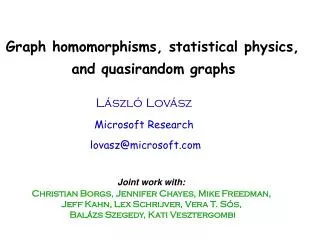
Graph homomorphisms, statistical physics, and quasirandom graphs László Lovász Microsoft Research lovasz@microsoft.com Joint work with: Christian Borgs, Jennifer Chayes, Mike Freedman, Jeff Kahn, Lex Schrijver, Vera T. Sós, Balázs Szegedy, Kati Vesztergombi
independent set coloring triangles Homomomorphism: adjacency-preserving map
probability that random map is a homomorphism every node in G weighted by 1/|V(G)| Homomorphism density: Homomorphism entropy:
if G has no loops Examples:
1 1 2 1 1 H 3 3 -1 1/4 1/4 -1 -1 -1 -1 1/4 1/4 -1 3 3 H
atoms are in states (e.g. up or down): energy of interaction: energy of state: partition function: Hom functions and statistical physics interaction only between neighboring atoms: graph G
sparse G bounded degree partition function: denseG All weights in H are 1 hard-core model H=Kq, all weights are positive soft-core model
: set of connected graphs Erdős – Lovász – Spencer Recall:
Kruskal-Katona Goodman 1 0 1/2 2/3 3/4 1 Bollobás Lovász-Simonovits
small probe (subgraph) small template (model) large graph
Kruskal-Katona Theorem for triangles: Turán’s Theorem for triangles: Erdős’s Theorem on quadrilaterals:
Connection matrix (for target graph G): Connection matrices k-labeled graph: k nodes labeled 1,...,k
... k=2: ...
reflection positivity Main Lemma: is positive semidefinite has rank
k=2 Proof of Kruskal-Katona k=1
How much does the positive semidefinite property capture? ...almost everything!
reflection positivity equality holds in “generic” case (H has no automorphism) is positive semidefinite has rank Connection matrix of a parameter: graph parameter
... finite sum is a commutative algebra with unit element Inner product: positive semidefinite suppose = k-labeled quantum graph:
Distance of graphs: Converse???
Example: Paley graphs p: prime 1 mod 4 Quasirandom graphs Thomason Chung – Graham – Wilson (Gn: n=1,2,...)is quasirandom, if d(Gn, G(n,p)) 0 a.s. How to see that these graphs are quasirandom?
For a sequence (Gn: n=1,2,...), the following are equivalent: (Gn) is quasirandom; simple graph F; for F=K2 and C4. Converse if G’ is a random graph. Chung – Graham – Wilson
k=1: 1 p ... ... ... ... p p2 ... ... pk pk+1 Suppose that Want:
k=2: 1 p2 p2 p4 ... ... p2k p2k+2 ... ... ... ...
1 pk ... ... ... ... pk p2k ... ... ... ... ... p|E(G’)| p|E(G)| ... ... ... ... k=deg(v)
density 0.2 0.1n 0.4n 0.2n 0.3n density 0.35 For a sequence (Gn: n=1,2,...), the following are equivalent: d(Gn, G(n,H)) 0; simple graph F; Generalized (quasi)random graphs 0.1 0.5 0.7 0.2 0.3 0.2 0.4 0.5 0.35 0.3
(Gn) left-convergent: (Gn) right-convergent: Recall:
Example: (C2n) is right-convergent But... (Cn) is not convergent for bipartite H
(Gn) left-convergent: e.g. H=Kq, q>8D Graphs with bounded degree D